


Air Temperature
| Highest Maximum | 19.7°C | 5th |
| Lowest Maximum | 13.0°C | 12th |
| Highest Minimum | 16.1°C | 5th |
| Lowest Minimum | 4.1°C | 13th |
| Mean Maximum | 16.6°C |
| Mean Minimum | 11.5°C |
| Mean | 14.1°C |
Relative Humidity
| Highest Relative Humidity | 95% | Numerous days |
| Lowest Relative Humidity | 59% | 10th |
| Mean Relative Humidity | 82.0% |
Wind
| Highest Gust | 64.4km/h | 20th |
| Mean Wind Speed | 14.8km/h |
| Most Frequent Wind Direction | Southeast |
Atmospheric Pressure
| Highest Atmospheric Pressure | 1028.3hPa | 13th |
| Lowest Atmospheric Pressure | 996.3hPa | 31st |
| Mean Atmospheric Pressure | 1011.8hPa |
Precipitation
| Total Rainfall During January 2026 | 111.9 mm |
| Total Rainfall Since Last 01/09 | 456.0 mm |
| Highest 24 Hour Total | 37.1 mm | 20th |
| Rain Days | 19 days |
| Thunderstorm Days | 2 days |
| Hail Days | 7 days |
Rainfall Events
| 01/01/2026 | 14.3 mm | Morning Periods of Rain |
| 02/01/2026 | 1.8 mm | Isolated Shower |
| 07/01/2026 | 5.9 mm | Afternoon and Evening Gusty Rain and Hail Showers |
| 08/01/2026 | 8.4 mm | Morning and Afternoon Gusty Rain and Hail Showers |
| 10/01/2026 | 0.8 mm | Evening Isolated Showers |
| 11/01/2026 | 3.3 mm | Gusty Rain and Hail Showers |
| 12/01/2026 | 0.0 mm | Distant Isolated Light Rain |
| 16/01/2026 | 9.2 mm | Steady Light Rain; Evening Thundery Rain and Hail Showers |
| 17/01/2026 | 1.9 mm | Morning Steady Light Rain; Distant Hailstorm |
| 19/01/2026 | 1.1 mm | Isolated Showers |
| 20/01/2026 | 37.1 mm | Steady Light Rain; Evening Heavy Thunderstorm with Hail |
| 21/01/2026 | 11.8 mm | Isolated Light Rain; Evening Steady Rain |
| 22/01/2026 | 1.5 mm | Morning Isolated Showers |
| 23/01/2026 | 1.5 mm | Isolated Showers |
| 25/01/2026 | 0.3 mm | Isolated Light Rain; Distant Steady Light Rain |
| 26/01/2026 | 4.8 mm | Showers |
| 27/01/2026 | 0.0 mm | Distant Isolated Showers |
| 28/01/2026 | 0.5 mm | Isolated Light Rain |
| 29/01/2026 | 2.5 mm | Isolated Showers |
| 30/01/2026 | 2.7 mm | Isolated Showers |
| 31/01/2026 | 2.5 mm | Isolated Showers; Distant Hail |
January 2026 Compared to the Climate Means
| Climate Mean | January 2026 | Anomaly | |
| Mean Maximum Temperature | 15.6°C | 16.6°C | +1.0°C |
| Mean Minimum Temperature | 10.1°C | 11.5°C | +1.4°C |
| Mean Temperature | 12.8°C | 14.1°C | +1.3°C |
| Mean Relative Humidity | 78.4% | 82.0% | +3.6% |
| Mean Atmospheric Pressure | 1021.7hPa | 1011.8hPa | -9.9hPa |
| Total Rainfall | 69.4 mm | 111.9 mm | +42.5 mm |
| Total Rainfall Since Last 01/09 | 385.5 mm | 456.0 mm | +70.5 mm |
| Total Rain Days | 14 days | 19 days | +5 days |
| Total Thunderstorm Days | 4 days | 2 days | -2 days |
| Total Hail Days | 2 days | 7 days | +5 days |
January 2026 brings Significant Rainfall and Storm Harry
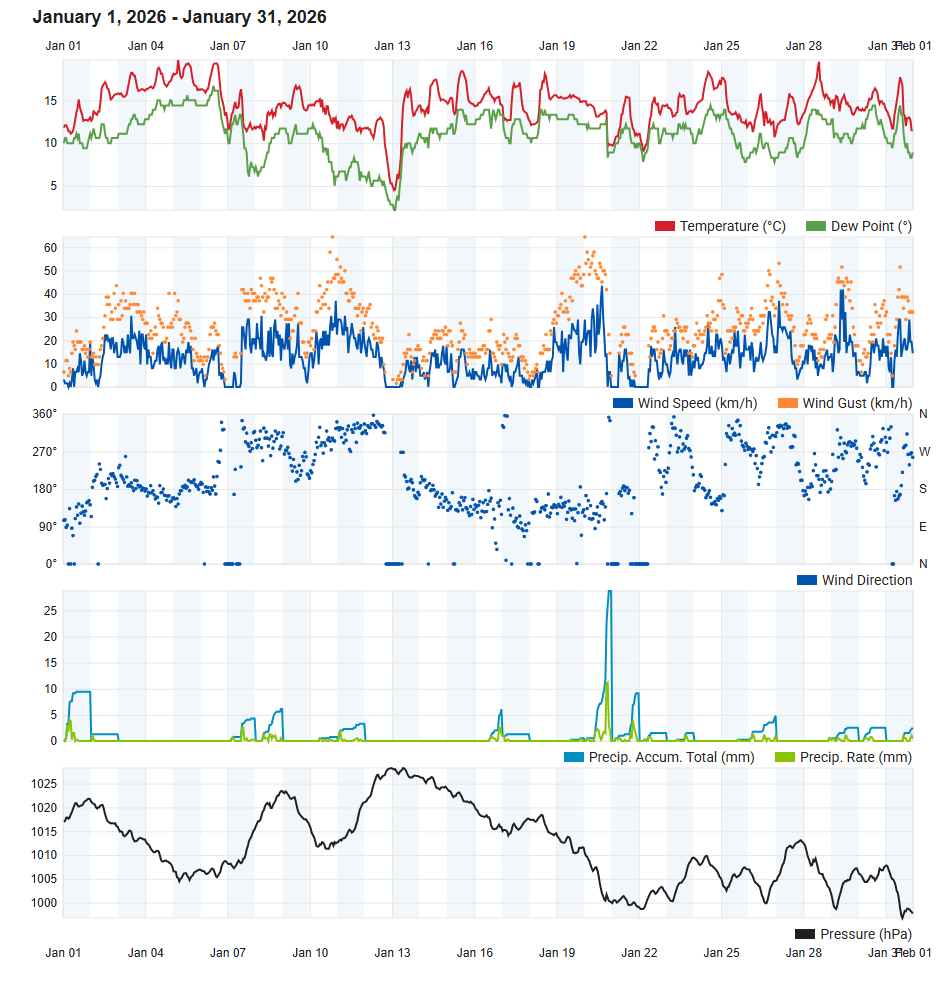
January 2026 was characterized by anomalously mild, humid and wet conditions. The mean air temperature, at 14.1°C, was 1.3°C above the climatological norm. This anomaly is evident in both daytime and night-time values, with a mean maximum of 16.6°C (+1.0°C) and a mean minimum of 11.5°C (+1.4°C). The warmest day occurred on the 5th (19.7°C), while the lowest minimum of the month, 4.1°C, was recorded on the 13th during a brief clearer and calmer interval.
The month was persistently moist, with mean relative humidity averaging 82%, above the long-term mean. Atmospheric pressure averaged 1011.8 hPa, a substantial 9.9 hPa below normal, reflecting frequent cyclonic incursions across the central Mediterranean and reduced anticyclonic dominance. Pressure ranged from 1028.3 hPa on the 13th to a deep 996.3 hPa on the 31st. Winds were predominantly southeasterly, with a mean speed of 14.8 km/h and a peak gust of 64.4 km/h on the 20th, consistent with repeated pre-frontal and warm-sector airflow episodes transporting moist maritime air towards the islands.
Rainfall was significantly above average. A total of 111.9 mm was measured during the month, exceeding the climate mean by 42.5 mm, while 19 rainy days were recorded – five more than normal. Since 1st September, cumulative rainfall reached 456.0 mm, confirming a wetter-than-average hydrological season to date. Spatially, precipitation totals were highest across western and elevated localities, including Mġarr (186.9 mm), Dingli (176.6 mm) and Żurrieq (166.6 mm), suggesting orographic enhancement under prevailing moist southeasterly flow. Lower totals were observed in more sheltered coastal areas such as Marsaxlokk (101.0 mm).
Two notable convective events headlined the month. On 17th January, an unusually intense hailstorm affected parts of Malta, particularly Rabat, where deep hail accumulations and localized drifts were reported. The event was associated with strong convection within a moist, unstable air mass enhanced by a relatively low freezing level and steep lapse rates, enabling efficient hail growth. Such accumulation events are rare in the Maltese Islands and indicative of vigorous updraft dynamics.
More significant was the passage of Storm Harry on 19th and 20th January, when a deep Mediterranean low developed within a broader European windstorm pattern. The system brought sustained strong southeasterly winds, heavy rainfall, thunderstorms and hail. On the 20th alone, 37.1 mm of rain was recorded — the highest 24-hour total of the month — alongside the strongest wind gust (64.4 km/h). Wind gusts of up to 100km/h were registered by several meteorological stations across the archipelago. The storm generated rough seas, coastal impacts and widespread weather-related disruption. Synoptically, the event reflected a well-developed pressure gradient and strong moisture advection ahead of the low centre, followed by the passage of a convectively active front.
Although only two thunderstorm days were recorded (below average), hail was observed on seven days, significantly above the climatological norm, indicating repeated episodes of cold upper-air intrusions and convective instability embedded within larger-scale disturbances.
Rainfall Totals around the Maltese Islands in January 2026 (and since last September 1st):
Kerċem: 111.9 mm (456.0 mm)
Victoria: 118.9 mm (462.1 mm)
Marsalforn: 103.7 mm (401.5 mm)
Xewkija: 104.1 mm (401.7 mm)
Nadur: 116.2 mm (409.8 mm)
Għajnsielem: 106.2 mm (409.0 mm)
Mellieħa: 127.6 mm (294.3 mm)
Buġibba: 107.5 mm (278.2 mm)
Mġarr: 186.9 mm (400.0 mm)
Naxxar: 134.7 mm (342.5 mm)
Mosta: 131.1 mm (315.7 mm)
Dingli: 176.6 mm (473.8 mm)
Pembroke: 116.4 mm (356.5 mm)
Msida: 116.4 mm (374.6 mm)
Sliema: 128.5 mm (376.1 mm)
Valletta: 109.1 mm (352.7 mm)
Fgura: 130.1 mm (373.4 mm)
Żejtun: 120.4 mm (349.3 mm)
Żabbar: 117.3 mm (316.8 mm)
Imqabba: 146.2 mm (449.1 mm)
Siġġiewi: 153.9 mm (455.2 mm)
Żurrieq: 166.6 mm (456.2 mm)
Marsaxlokk: 101.0 mm (314.2 mm)
NATIONAL MEAN: 126.0 mm (382.2 mm)