


Air Temperature
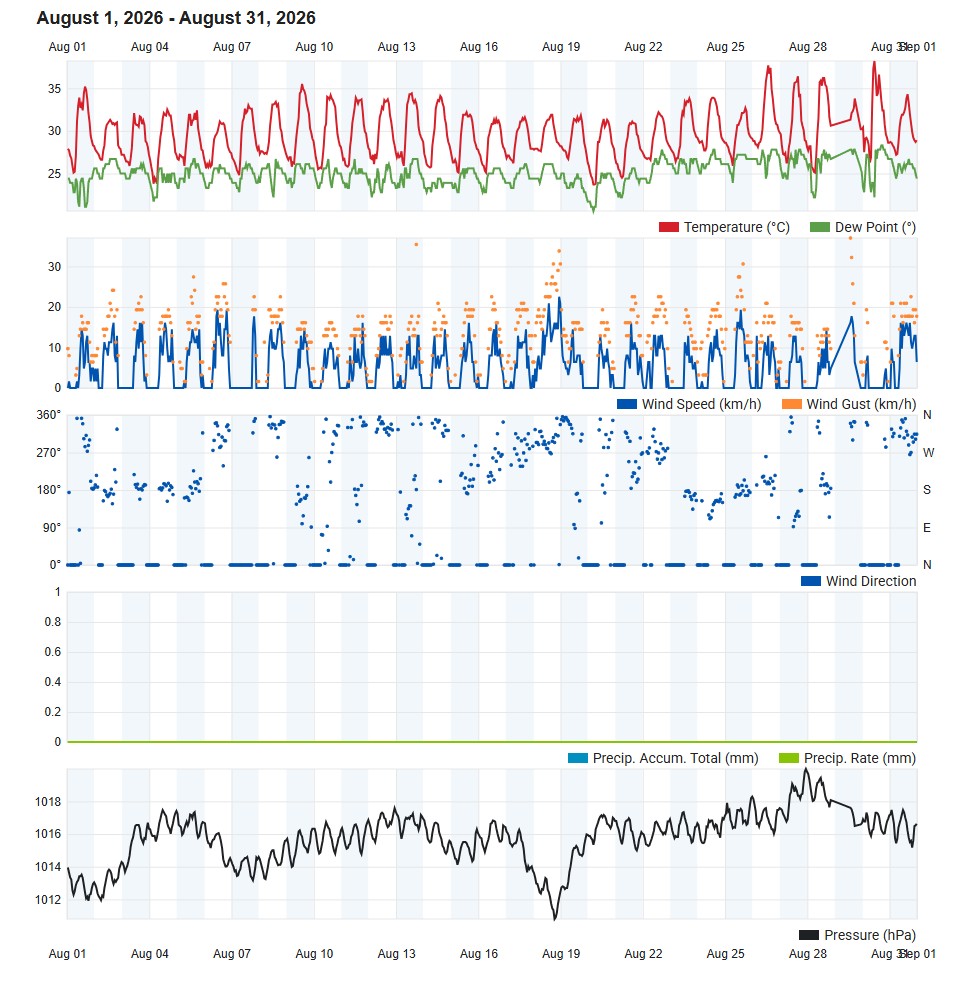
| Highest Maximum | 38.2°C | 30th |
| Lowest Maximum | 31.1°C | 21st |
| Highest Minimum | 27.9°C | 26th |
| Lowest Minimum | 23.2°C | 4th |
| Mean Maximum | 33.6°C |
| Mean Minimum | 25.5°C |
| Mean | 29.6°C |
Relative Humidity
| Highest Relative Humidity | 92% | Numerous days |
| Lowest Relative Humidity | 32% | 30th |
| Mean Relative Humidity | 77.9% |
Wind
| Highest Gust | 37.0km/h | 29th |
| Days with Force 5 (29 – 38kph) | 6 days |
| Days with Force 6 (39 – 49kph) | 0 days |
| Days with Force 7 (50 – 61kph) | 0 days |
| Days with Force 8 (62 – 74kph) | 0 days |
| Days with Force 9 (75 – 88kph) | 0 days |
| Days with Force 10+ (89kph+) | 0 days |
| Mean Wind Speed | 5.8km/h |
| Most Frequent Wind Direction | North Northwest |
Atmospheric Pressure
| Highest Atmospheric Pressure | 1020.0hPa | 27th |
| Lowest Atmospheric Pressure | 1010.7hPa | 18th |
| Mean Atmospheric Pressure | 1015.7hPa |
Precipitation
| Total Rainfall During August2026 | 0.0 mm |
| Total Rainfall Since Last 01/09 | 545.8 mm |
| Highest 24 Hour Total | 0.0 mm | / |
| Rain Days | 0 days |
| Thunderstorm Days | 0 days |
| Hail Days | 0 days |
August 2026 Compared to the Climate Means
| Climate Mean | August2026 | Anomaly | |
| Mean Maximum Temperature | 31.7°C | 33.6°C | +1.9°C |
| Mean Minimum Temperature | 23.3°C | 25.5°C | +2.2°C |
| Mean Temperature | 27.5°C | 29.6°C | +2.1°C |
| Mean Relative Humidity | 73.6% | 77.9% | +4.3% |
| Mean Atmospheric Pressure | 1014.1hPa | 1015.7hPa | +1.6hPa |
| Total Rainfall | 10.6 mm | 0.0 mm | -10.6 mm |
| Total Rainfall Since Last 01/09 | 529.8 mm | 545.8 mm | +16.0 mm |
| Total Rain Days | 1 day | 0 days | -1 day |
| Total Thunderstorm Days | 1 day | 0 days | -1 day |
| Total Hail Days | 0 days | 0 days | / |
August 2026: The Hottest August on Record in the Maltese Islands
August 2026 brought no meaningful respite from July’s exceptional heat. Instead, the Maltese Islands experienced another persistently hot and humid month – and one that ultimately entered the meteorological record books as the hottest August ever recorded in the Maltese Islands. Unlike July, which was distinguished by extraordinary individual temperature extremes, August was remarkable for the sheer persistence of the heat, both by day and by night.
At Kerċem, the mean air temperature reached 29.6°C, standing a substantial 2.1°C above the climatological average. Mean maximum temperature reached 33.6°C (+1.9°C), while mean minimum temperature climbed to 25.5°C (+2.2°C). The greater anomaly in minimum temperatures once again highlights one of the defining characteristics of summer 2026: exceptionally limited nocturnal cooling.
The hottest day at Kerċem occurred on the 30th, when the temperature reached 38.2°C, while the highest minimum of 27.9°C was recorded on the 26th. Yet perhaps the most revealing statistic is at the opposite end of the scale: the lowest maximum temperature of the entire month was still 31.1°C, while the lowest minimum was 23.2°C. Every single day therefore exceeded 31°C, and every night remained comfortably above the conventional 20°C tropical-night threshold. August’s record warmth was consequently not the product of one short-lived extreme event, but of heat maintained relentlessly throughout the month.
The high temperatures were accompanied by unusually humid conditions. Mean relative humidity reached 77.9%, some 4.3 percentage points above normal. With the surrounding Mediterranean exceptionally warm following months of accumulated summer heating, nocturnal cooling remained limited, while the combination of high temperatures and humidity frequently produced oppressive conditions after sunset. This also helps explain why the positive anomaly in minimum temperatures (+2.2°C) exceeded that of daytime maxima (+1.9°C).
Wind conditions formed another important part of the month’s meteorological character. Mean wind speed was just 5.8 km/h, with north-northwesterly winds most frequent. Only six days reached Force 5, none reached Force 6 or stronger, and the month’s highest gust was just 37.0 km/h on the 29th. The general lack of stronger northwesterly circulation meant fewer opportunities for significant ventilation and upper-sea level mixing, contributing to the persistence of warm, humid conditions.
Atmospheric pressure averaged 1015.7 hPa, around 1.6 hPa above normal, while varying within a relatively narrow range between 1010.7 hPa on the 18th and 1020.0 hPa on the 27th. This was consistent with the general absence of significant synoptic disturbances affecting the central Mediterranean during the month.
Rainfall was completely absent. No measurable precipitation was recorded anywhere across the Maltese Islands during August, while Kerċem’s climatological August average stands at 10.6 mm. There were consequently no rain days, thunderstorm days or hail days. Coming after 0.0 mm in June and just 0.3 mm in July, this meant that Kerċem received a remarkable 0.3 mm of rain during the entire meteorological summer.
Despite the exceptionally dry conclusion to summer, the rainfall year ending on 31 August 2026 closed at 545.8 mm at Kerċem, some 16.0 mm above the climatological total. Rain accumulated during the wetter part of the year was therefore sufficient to preserve an overall surplus despite the prolonged summer drought.
Rainfall Totals around the Maltese Islands in August2026 (and since last September 1st):
Kerċem: 0.0 mm (545.8 mm)
Victoria: 0.0 mm (547.3 mm)
Marsalforn: 0.0 mm (494.3 mm)
Xewkija: 0.0 mm (470.3 mm)
Nadur: 0.0 mm (496.1 mm)
Għajnsielem: 0.0 mm (500.9 mm)
Mellieħa: 0.0 mm (367.5 mm)
Buġibba: 0.0 mm (356.9 mm)
Mġarr: 0.0 mm (502.7 mm)
Naxxar: 0.0 mm (427.7 mm)
Mosta: 0.0 mm (392.6 mm)
Dingli: 0.0 mm (544.7 mm)
Pembroke: 0.0 mm (433.9 mm)
Msida: 0.0 mm (456.1 mm)
Sliema: 0.0 mm (451.1 mm)
Valletta: 0.0 mm (407.8 mm)
Fgura: 0.0 mm (462.7 mm)
Żejtun: 0.0 mm (411.3 mm)
Żabbar: 0.0 mm (381.2 mm)
Imqabba: 0.0 mm (546.6 mm)
Siġġiewi: 0.0 mm (535.8 mm)
Żurrieq: 0.0 mm (543.6 mm)
Marsaxlokk: 0.0 mm (379.2 mm)
NATIONAL MEAN: 0.0 mm (461.4 mm)