


Air Temperature
| Highest Maximum | 19.4°C | 6th |
| Lowest Maximum | 15.4°C | 15th and 16th |
| Highest Minimum | 14.7°C | 12th |
| Lowest Minimum | 8.0°C | 27th |
| Mean Maximum | 17.1°C |
| Mean Minimum | 12.1°C |
| Mean | 14.6°C |
Relative Humidity
| Highest Relative Humidity | 95% | Numerous days |
| Lowest Relative Humidity | 63% | 17th |
| Mean Relative Humidity | 82.3% |
Wind
| Highest Gust | 54.7km/h | 12th |
| Days with Force 5 (29 – 38kph) | 7 days |
| Days with Force 6 (39 – 49kph) | 9 days |
| Days with Force 7 (50 – 61kph) | 2 days |
| Days with Force 8 (62 – 74kph) | 3 days |
| Days with Force 9 (75 – 88kph) | 0 days |
| Days with Force 10+ (89kph+) | 0 days |
| Mean Wind Speed | 15.1km/h |
| Most Frequent Wind Direction | West |
Atmospheric Pressure
| Highest Atmospheric Pressure | 1028.1hPa | 27th |
| Lowest Atmospheric Pressure | 995.2hPa | 14th |
| Mean Atmospheric Pressure | 1013.2hPa |
Precipitation
| Total Rainfall During February 2026 | 26.5 mm |
| Total Rainfall Since Last 01/09 | 482.5 mm |
| Highest 24 Hour Total | 7.0 mm | 20th |
| Rain Days | 11 days |
| Thunderstorm Days | 1 day |
| Hail Days | 1 day |
Rainfall Events
| 01/02/2026 | 2.5 mm | Isolated Showers |
| 02/02/2026 | 0.3 mm | Morning Isolated Light Rain |
| 07/02/2026 | 3.2 mm | Afternoon and Evening Light Rain |
| 08/02/2026 | 0.0 mm | Distant Isolated Light Rain |
| 09/02/2026 | 3.2 mm | Isolated Showers |
| 10/02/2026 | 1.6 mm | Afternoon Light Rain |
| 11/02/2026 | 0.3 mm | Isolated Light Rain |
| 12/02/2026 | 2.0 mm | Isolated Showers with Hail |
| 14/02/2026 | 0.3 mm | Morning Isolated Light Rain; Airborne Dust |
| 15/02/2026 | 5.6 mm | Steady Light Rain |
| 16/02/2026 | 0.5 mm | Isolated Showers |
| 17/02/2026 | 0.0 mm | Distant Isolated Light Rain |
| 20/02/2026 | 7.0 mm | Steady Rain; Distant Thunder |
February 2026 Compared to the Climate Means
| Climate Mean | February 2026 | Anomaly | |
| Mean Maximum Temperature | 15.6°C | 17.1°C | +1.5°C |
| Mean Minimum Temperature | 9.7°C | 12.1°C | +2.4°C |
| Mean Temperature | 12.7°C | 14.6°C | +1.9°C |
| Mean Relative Humidity | 78.3% | 82.3% | +4.0% |
| Mean Atmospheric Pressure | 1020.2hPa | 1013.2hPa | -7.0hPa |
| Total Rainfall | 61.9 mm | 26.5 mm | -35.4 mm |
| Total Rainfall Since Last 01/09 | 447.5 mm | 482.5 mm | +35.0 mm |
| Total Rain Days | 11 days | 11 days | / |
| Total Thunderstorm Days | 3 days | 1 day | -2 days |
| Total Hail Days | 2 days | 1 day | -1 day |
Windy but Surprisingly Warm and Dry in February 2026
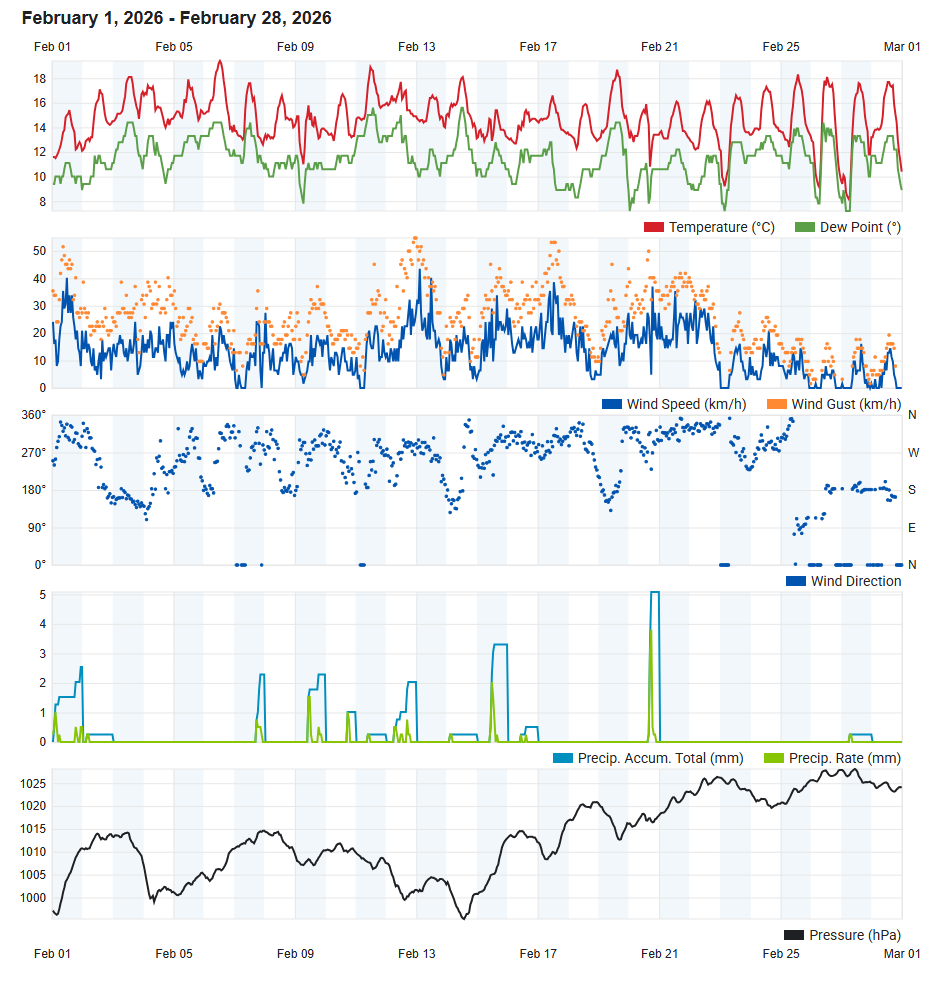
February 2026 continued the winter’s anomalously mild pattern across the Maltese Islands, though in sharp contrast to January it was significantly drier than average. The month was characterized by elevated temperatures, frequent westerly winds, suppressed rainfall totals, and persistently below-normal atmospheric pressure.
The mean air temperature clocked in at 14.6°C, which is 1.9°C above the climatological norm – an even stronger positive anomaly than January. Both daytime and night-time values reflected this. The mean maximum temperature stood at 17.1°C (+1.5°C), while the mean minimum rounded off at 12.1°C, a notable +2.4°C anomaly. The particularly strong elevation in minimum temperatures indicates sustained cloud cover and moist boundary-layer conditions limiting nocturnal cooling. The warmest day occurred on the 6th (19.4°C), while the lowest minimum of 8.0°C was recorded on the 27th during a brief anticyclonic interval.
Relative humidity averaged 82.3%, exceeding the long-term mean by 4.0%, reinforcing the impression of a persistently moist lower troposphere. Atmospheric pressure averaged 1013.2 hPa, which is 7.0 hPa below normal, confirming that cyclonic systems and Atlantic-derived disturbances remained influential across the central Mediterranean. Pressure ranged from 1028.1 hPa on the 27th – coinciding with the coolest minimum – to a deep 995.2 hPa on the 14th.
Wind conditions were a defining feature of the month. The most frequent wind direction was west, signaling a shift from January’s southeasterly dominance toward a more Atlantic-driven regime. Mean wind speed was 15.1 km/h, but several days experienced moderate to strong winds. Seven days recorded Force 5 winds, nine days Force 6, two days Force 7, and three days reached Force 8. The frequency of Force 6–8 days highlights a dynamically active month with repeated frontal passages.
Despite the active synoptic environment, rainfall totals were markedly suppressed. Only 26.5 mm of precipitation was measured, representing a deficit of 35.4 mm compared to the February mean of 61.9 mm. Rain fell on 11 days – consistent with climatological norms – but events were generally light and short-lived. The highest 24-hour total was just 7.0 mm on the 20th during a period of steady rain with distant thunder. Only one thunderstorm day and one hail day were recorded, both below average.
The rainfall regime suggests that while frontal systems affected the islands, they were either moisture-limited, fast-moving, or poorly organized locally. The predominance of a westerly flow may also have reduced orographic enhancement compared to January’s southeasterly episodes. Spatially, rainfall remained modest across the archipelago. The national mean was 21.1 mm, with slightly higher accumulations in Żurrieq (30.5 mm), Marsalforn (32.1 mm), and Imqabba (28.9 mm), and lower totals in Valletta (12.9 mm), Buġibba (13.4 mm), and Mosta (13.5 mm). The distribution was relatively even overall, reflecting the absence of prolonged convective or orographically enhanced events.
Although February itself was dry, cumulative rainfall since 1 September now stands at 482.5 mm, placing the hydrological season 35.0 mm above average by month’s end. This indicates that January’s surplus has more than compensated for February’s deficit.
Rainfall Totals around the Maltese Islands in February 2026 (and since last September 1st):
Kerċem: 26.5 mm (482.5 mm)
Victoria: 23.8 mm (485.9 mm)
Marsalforn: 32.1 mm (433.6 mm)
Xewkija: 15.7 mm (417.4 mm)
Nadur: 24.0 mm (433.8 mm)
Għajnsielem: 27.7 mm (436.7 mm)
Mellieħa: 18.9 mm (313.2 mm)
Buġibba: 13.4 mm (291.6 mm)
Mġarr: 21.9 mm (421.9 mm)
Naxxar: 18.3 mm (360.8 mm)
Mosta: 13.5 mm (329.2 mm)
Dingli: 15.7 mm (489.5 mm)
Pembroke: 23.0 mm (379.5 mm)
Msida: 19.0 mm (393.6 mm)
Sliema: 19.8 mm (395.9 mm)
Valletta: 12.9 mm (365.6 mm)
Fgura: 23.5 mm (396.9 mm)
Żejtun: 16.4 mm (365.7 mm)
Żabbar: 19.1 mm (335.9 mm)
Imqabba: 28.9 mm (478.0 mm)
Siġġiewi: 26.2 mm (481.4 mm)
Żurrieq: 30.5 mm (486.7 mm)
Marsaxlokk: 17.8 mm (332.0 mm)
NATIONAL MEAN: 21.1 mm (403.3 mm)