


Air Temperature
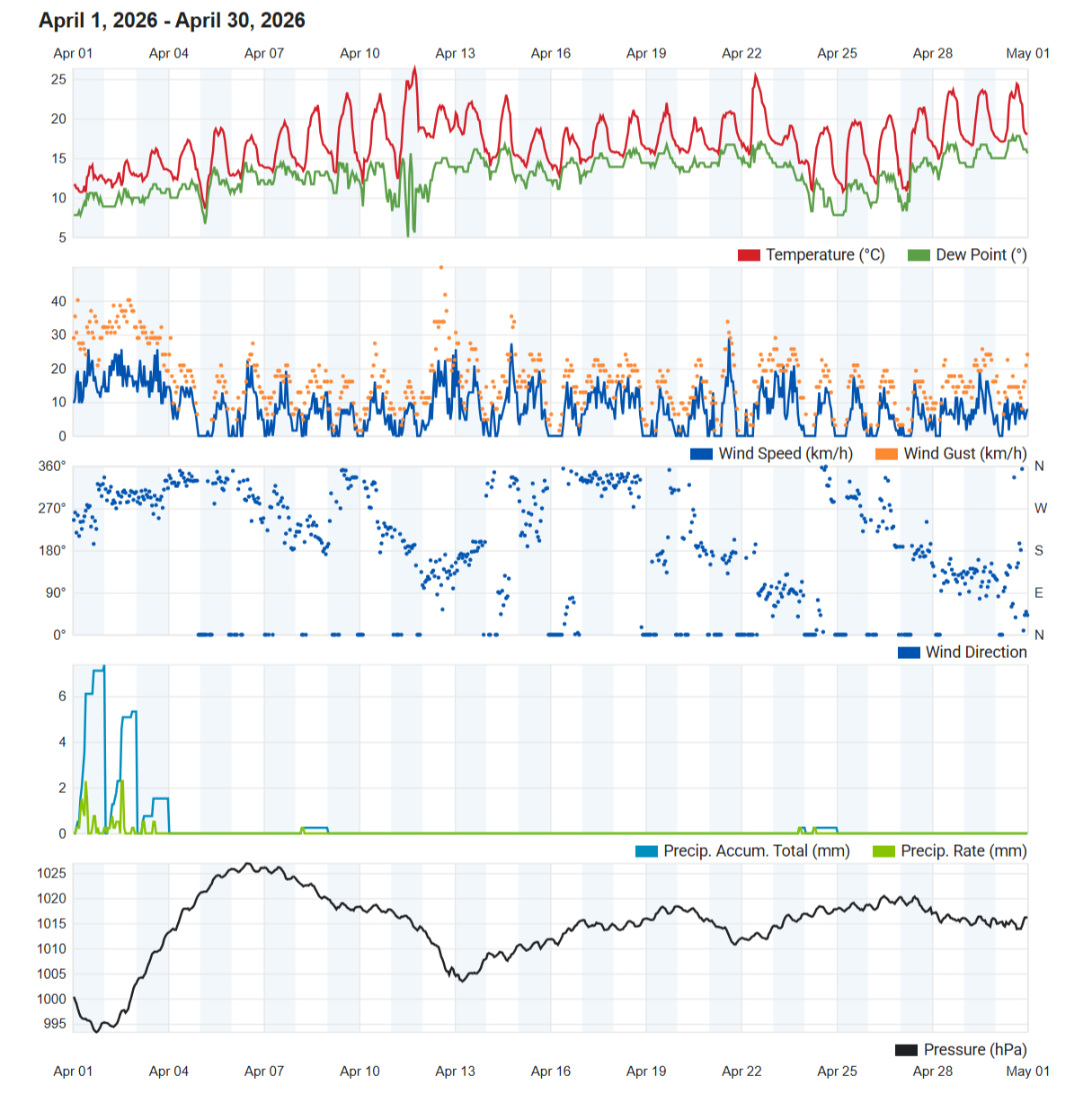
| Highest Maximum | 26.3°C | 11th |
| Lowest Maximum | 14.1°C | 1st |
| Highest Minimum | 17.3°C | 12th |
| Lowest Minimum | 8.4°C | 5th |
| Mean Maximum | 20.6°C |
| Mean Minimum | 13.0°C |
| Mean | 16.8°C |
Relative Humidity
| Highest Relative Humidity | 92% | Numerous days |
| Lowest Relative Humidity | 25% | 11th |
| Mean Relative Humidity | 78.9% |
Wind
| Highest Gust | 49.9km/h | 12th |
| Days with Force 5 (29 – 38kph) | 4 days |
| Days with Force 6 (39 – 49kph) | 3 days |
| Days with Force 7 (50 – 61kph) | 1 day |
| Days with Force 8 (62 – 74kph) | 0 days |
| Days with Force 9 (75 – 88kph) | 0 days |
| Days with Force 10+ (89kph+) | 0 days |
| Mean Wind Speed | 9.0km/h |
| Most Frequent Wind Direction | West |
Atmospheric Pressure
| Highest Atmospheric Pressure | 1026.9hPa | 6th |
| Lowest Atmospheric Pressure | 993.0hPa | 1st |
| Mean Atmospheric Pressure | 1014.5hPa |
Precipitation
| Total Rainfall During April 2026 | 18.6 mm |
| Total Rainfall Since Last 01/09 | 536.3 mm |
| Highest 24 Hour Total | 9.2 mm | 1st |
| Rain Days | 6 days |
| Thunderstorm Days | 0 days |
| Hail Days | 0 days |
Rainfall Events
| 01/04/2026 | 9.2 mm | Showers |
| 02/04/2026 | 6.6 mm | Showers |
| 03/04/2026 | 1.9 mm | Showers |
| 08/04/2026 | 0.3 mm | Dewfall |
| 16/04/2026 | 0.0 mm | Distant Isolated Light Rain |
| 23/04/2026 | 0.3 mm | Isolated Light Rain |
| 24/04/2026 | 0.3 mm | Isolated Light Rain |
April 2026 Compared to the Climate Means
| Climate Mean | April 2026 | Anomaly | |
| Mean Maximum Temperature | 19.8°C | 20.6°C | +0.8°C |
| Mean Minimum Temperature | 13.0°C | 13.0°C | / |
| Mean Temperature | 16.4°C | 16.8°C | +0.4°C |
| Mean Relative Humidity | 77.1% | 78.9% | +1.8% |
| Mean Atmospheric Pressure | 1016.3hPa | 1014.5hPa | -1.8hPa |
| Total Rainfall | 17.0 mm | 18.6 mm | +1.6 mm |
| Total Rainfall Since Last 01/09 | 504.8 mm | 536.3 mm | +31.5 mm |
| Total Rain Days | 6 days | 6 days | / |
| Total Thunderstorm Days | 1 day | 0 days | -1 day |
| Total Hail Days | 0 days | 0 days | / |
A Calmer but Mild April Signals Spring’s Gradual Arrival Across the Maltese Islands
April 2026 marked a notable shift toward more settled springtime conditions across the Maltese Islands, with lighter winds, fewer disturbances and reduced rainfall compared to the preceding months. Nevertheless, the atmosphere remained somewhat humid and weakly cyclonic, while temperatures stayed slightly above seasonal norms overall.
The mean air temperature reached 16.8°C, which is 0.4°C above the climatological average. Unlike the pronounced winter warmth observed earlier in the year, April’s anomaly was more modest and primarily driven by elevated daytime temperatures. The mean maximum temperature stood at 20.6°C (+0.8°C), while the mean minimum of 13.0°C aligned exactly with the long-term norm. The month’s warmest day occurred on the 11th, when temperatures climbed to 26.3°C under notably dry air, marking the first distinctly early-summer-like conditions of the year. In contrast, the coolest day was recorded on the 1st, when the maximum reached only 14.1°C under unsettled weather associated with a deep low-pressure system.
Humidity remained relatively elevated for the season, averaging 78.9%, though this represented a slight reduction compared to previous months. Particularly notable was the sharp drop to 25% relative humidity on the 11th, coinciding with the month’s highest temperature and likely associated with a dry continental airflow. This created one of the driest air masses experienced so far in 2026.
Atmospheric pressure averaged 1014.5 hPa, remaining 1.8 hPa below normal, suggesting that while spring anticyclonic conditions became more frequent, cyclonic influence had not entirely disappeared from the central Mediterranean. Pressure ranged from a deep 993.0 hPa on the 1st – the lowest pressure observed so far in 2026 – to 1026.9 hPa on the 6th during a more stable interval.
Wind conditions eased considerably compared to February and March. The mean wind speed fell to 9.0 km/h, reflecting the gradual weakening of the winter pressure gradient across the region. Westerly winds were most frequent during the month, suggesting continued Atlantic influence at times, though without the intensity observed earlier in the season. Only eight days recorded Force 5 or stronger winds, including one Force 7 day. The strongest gust reached 49.9 km/h on the 12th.
Rainfall totals were close to average overall. A total of 18.6 mm was measured during the month, slightly above the climatological mean by 1.6 mm, while exactly 6 rain days were recorded – matching the seasonal norm. However, nearly all precipitation occurred during the opening days of the month. Between the 1st and 3rd alone, 17.7 mm fell, accounting for over 95% of April’s total rainfall. Thereafter, conditions became markedly drier, with only isolated light rain and dewfall events recorded.
The wet start to the month was linked to a deep Mediterranean depression centered near the region on the 1st, producing showers and the month’s highest 24-hour rainfall total of 9.2 mm. Despite the unsettled opening, convective activity was notably subdued overall. No thunderstorm or hail days were recorded during April, highlighting the absence of significant atmospheric instability and suggesting that frontal systems affecting the islands were relatively weak and shallow in vertical development.
Rainfall distribution across the islands was fairly uniform, though slightly lower totals were observed in southeastern coastal localities such as Valletta (8.5 mm) and Żejtun (8.2 mm). Higher accumulations occurred in Għajnsielem (21.6 mm), Marsalforn (20.6 mm), and Nadur (19.6 mm), though spatial contrasts were considerably weaker than during the winter months.
Cumulatively, rainfall since 1 September reached 536.3 mm, maintaining a 31.5 mm surplus above the long-term average despite the generally subdued precipitation patterns of late winter and early spring.
Rainfall Totals around the Maltese Islands in April 2026 (and since last September 1st):
Kerċem: 18.6 mm (536.3 mm)
Victoria: 17.4 mm (538.6 mm)
Marsalforn: 20.6 mm (486.6 mm)
Xewkija: 19.2 mm (465.1 mm)
Nadur: 19.6 mm (488.9 mm)
Għajnsielem: 21.6 mm (494.8 mm)
Mellieħa: 16.4 mm (363.2 mm)
Buġibba: 17.0 mm (354.8 mm)
Mġarr: 13.2 mm (497.5 mm)
Naxxar: 17.7 mm (422.3 mm)
Mosta: 17.0 mm (388.8 mm)
Dingli: 15.5 mm (539.6 mm)
Pembroke: 13.8 mm (428.7 mm)
Msida: 16.8 mm (451.5 mm)
Sliema: 12.8 mm (444.0 mm)
Valletta: 8.5 mm (401.6 mm)
Fgura: 16.5 mm (458.1 mm)
Żejtun: 8.2 mm (407.0 mm)
Żabbar: 15.6 mm (377.4 mm)
Imqabba: 18.2 mm (544.6 mm)
Siġġiewi: 14.0 mm (532.7 mm)
Żurrieq: 17.5 mm (539.6 mm)
Marsaxlokk: 11.7 mm (374.8 mm)
NATIONAL MEAN: 15.9 mm (456.0 mm)