


Air Temperature
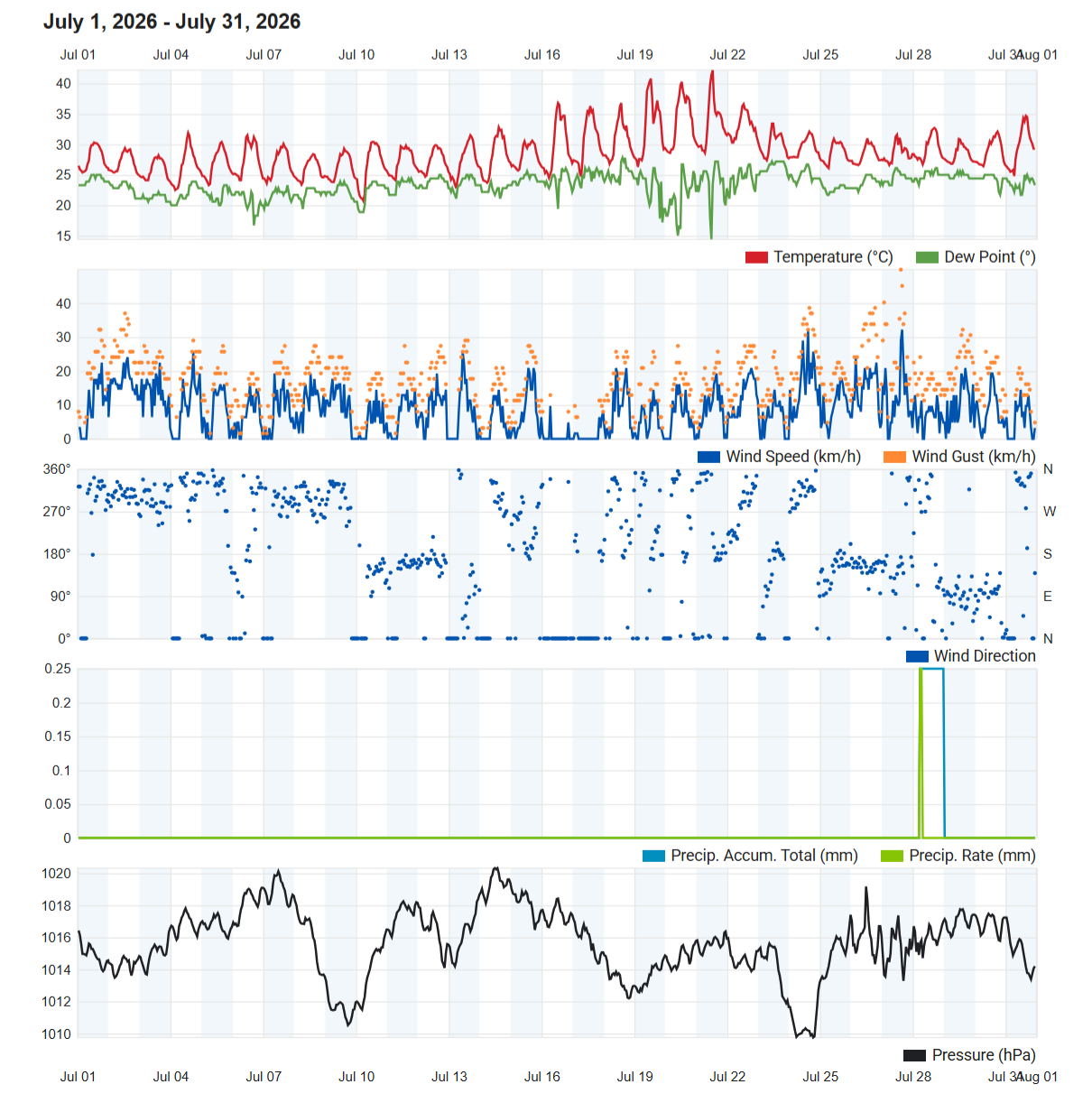
| Highest Maximum | 42.3°C | 21st |
| Lowest Maximum | 28.2°C | 3rd |
| Highest Minimum | 29.4°C | 22nd |
| Lowest Minimum | 20.4°C | 10th |
| Mean Maximum | 32.7°C |
| Mean Minimum | 24.9°C |
| Mean | 28.4°C |
Relative Humidity
| Highest Relative Humidity | 92% | Numerous days |
| Lowest Relative Humidity | 18% | 21st |
| Mean Relative Humidity | 75.0% |
Wind
| Highest Gust | 49.9km/h | 27th |
| Days with Force 5 (29 – 38kph) | 7 days |
| Days with Force 6 (39 – 49kph) | 2 days |
| Days with Force 7 (50 – 61kph) | 0 days |
| Days with Force 8 (62 – 74kph) | 0 days |
| Days with Force 9 (75 – 88kph) | 0 days |
| Days with Force 10+ (89kph+) | 0 days |
| Mean Wind Speed | 9.2km/h |
| Most Frequent Wind Direction | Northwest |
Atmospheric Pressure
| Highest Atmospheric Pressure | 1020.3hPa | 14th |
| Lowest Atmospheric Pressure | 1009.2hPa | 24th |
| Mean Atmospheric Pressure | 1015.6hPa |
Precipitation
| Total Rainfall During July2026 | 0.3 mm |
| Total Rainfall Since Last 01/09 | 545.8 mm |
| Highest 24 Hour Total | 0.3 mm | 28th |
| Rain Days | 1 days |
| Thunderstorm Days | 1 days |
| Hail Days | 0 days |
Rainfall Events
| 27/07/2026 | 0.0 mm | Distant Isolated Light Rain |
| 28/07/2026 | 0.3 mm | Isolated Light Rain; Thunder |
July 2026 Compared to the Climate Means
| Climate Mean | July2026 | Anomaly | |
| Mean Maximum Temperature | 31.6°C | 32.7°C | +1.1°C |
| Mean Minimum Temperature | 22.5°C | 24.9°C | +2.4°C |
| Mean Temperature | 27.0°C | 28.4°C | +1.4°C |
| Mean Relative Humidity | 70.2% | 75.0% | +4.8% |
| Mean Atmospheric Pressure | 1014.6hPa | 1015.6hPa | +1.0hPa |
| Total Rainfall | 0.2 mm | 0.3 mm | +0.1 mm |
| Total Rainfall Since Last 01/09 | 524.1 mm | 545.8 mm | +21.7 mm |
| Total Rain Days | 0 days | 1 day | +1 day |
| Total Thunderstorm Days | 0 days | 1 day | +1 day |
| Total Hail Days | 0 days | 0 days | / |
July 2026: A Month of Relentless Heat and Tropical Nights
July 2026 will be remembered as one of the most remarkable summer months in recent Maltese climatology. A prolonged spell of exceptional heat, record-breaking daytime temperatures, unusually warm nights and persistently high humidity combined to produce conditions that felt relentless, even by Mediterranean standards. While maximum temperatures exceeded 42°C during the month’s peak heatwave, it was the lack of overnight relief that truly defined July.
The mean air temperature reached 28.4°C, making the month 1.4°C warmer than the climatological average. Both daytime and night-time temperatures were above normal, with a mean maximum of 32.7°C (+1.1°C) and an exceptional mean minimum of 24.9°C (+2.4°C). The hottest day occurred on the 21st, when Kerċem recorded 42.3°C, while the following morning brought the month’s highest minimum temperature of 29.4°C, illustrating how little cooling occurred overnight. In total, 26 of the month’s 31 nights were warmer than average, including 16 consecutive above-average nights, making the persistent overnight warmth one of the defining characteristics of the month.
These exceptionally warm nights were closely linked to the ongoing Mediterranean marine heatwave, which kept sea surface temperatures well above normal. Combined with frequent southerly airflow during the heatwave, the unusually warm sea limited nocturnal cooling and maintained elevated humidity levels. Mean relative humidity averaged 75.0%, almost 5% above the long-term mean, with overnight values frequently exceeding 90%. Despite the intense daytime heat, the atmosphere therefore remained uncomfortably humid, especially during the night.
The month’s heatwave also proved exceptional from a climatological perspective. On 18 July, the Malta Meteorological Office recorded a maximum temperature of 43.3°C, establishing a new record for the highest temperature ever measured during the month of July. The event was further distinguished by an unprecedented sequence of three consecutive days with maximum temperatures of 42°C or higher, recorded between 18 and 20 July during a severe seven-day heatwave. This marked the first time such sustained extreme temperatures have been documented in Malta’s instrumental meteorological record, highlighting both the intensity and persistence of the event.
Atmospheric pressure averaged 1015.6 hPa, close to the climatological average, reflecting alternating periods of subtropical ridging and weak summer disturbances. Winds remained generally light, averaging 9.2 km/h, with the northwesterly prevailing for much of the month outside the heatwave period. The strongest gust reached 49.9 km/h on the 27th.
Although July is climatologically Malta’s driest month, the atmosphere was not completely devoid of instability. During the final week of the month, isolated thunderstorms developed over parts of the islands as a weak upper-level disturbance crossed the central Mediterranean. However, the dry lower atmosphere prevented significant rainfall from reaching the ground. Kerċem recorded just 0.3 mm of rain on the 28th, while most observing stations measured no precipitation at all. Nevertheless, the month officially recorded one rain day and one thunderstorm day, both slightly above the climatological average for July.
Despite the virtually rain-free month, cumulative rainfall since 1 September reached 545.8 mm, maintaining a 21.7 mm surplus above the long-term average thanks to the exceptionally wet conditions experienced during the earlier part of the hydrological year.
Rainfall Totals around the Maltese Islands in July2026 (and since last September 1st):
Kerċem: 0.3 mm (545.8 mm)
Victoria: 0.0 mm (547.3 mm)
Marsalforn: 0.0 mm (494.3 mm)
Xewkija: 0.0 mm (470.3 mm)
Nadur: 0.0 mm (496.1 mm)
Għajnsielem: 0.0 mm (500.9 mm)
Mellieħa: 0.0 mm (367.5 mm)
Buġibba: 0.0 mm (356.9 mm)
Mġarr: 0.0 mm (502.7 mm)
Naxxar: 0.0 mm (427.7 mm)
Mosta: 0.0 mm (392.6 mm)
Dingli: 0.0 mm (544.7 mm)
Pembroke: 0.0 mm (433.9 mm)
Msida: 0.0 mm (456.1 mm)
Sliema: 1.5 mm (451.1 mm)
Valletta: 1.8 mm (407.8 mm)
Fgura: 0.0 mm (462.7 mm)
Żejtun: 0.0 mm (411.3 mm)
Żabbar: 0.0 mm (381.2 mm)
Imqabba: 0.0 mm (546.6 mm)
Siġġiewi: 0.0 mm (535.8 mm)
Żurrieq: 0.3 mm (543.6 mm)
Marsaxlokk: 0.0 mm (379.2 mm)
NATIONAL MEAN: 0.2 mm (461.4 mm)