


Air Temperature
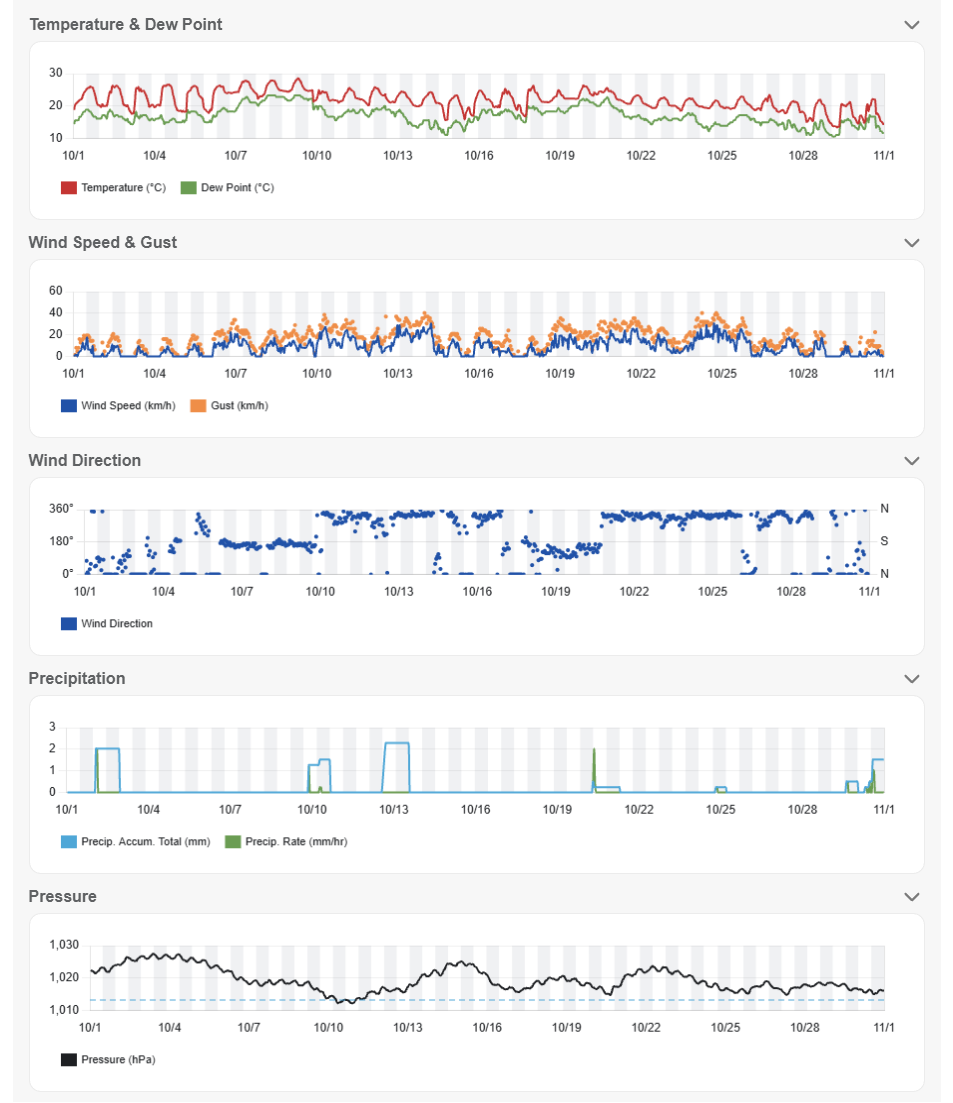
| Highest Maximum | 28.6°C | 9th |
| Lowest Maximum | 21.3°C | 30th |
| Highest Minimum | 24.4°C | 9th |
| Lowest Minimum | 12.7°C | 30th |
| Mean Maximum | 24.7°C |
| Mean Minimum | 18.6°C |
| Mean | 21.6°C |
Relative Humidity
| Highest Relative Humidity | 91% | Numerous days |
| Lowest Relative Humidity | 45% | 14th |
| Mean Relative Humidity | 75.0% |
Wind
| Highest Gust | 40.2km/h | 25th |
| Days with Force 5 (29 – 38kph) | 8 days |
| Days with Force 6 (39 – 49kph) | 3 days |
| Days with Force 7 (50 – 61kph) | 0 days |
| Days with Force 8 (62 – 74kph) | 0 days |
| Days with Force 9 (75 – 88kph) | 0 days |
| Days with Force 10+ (89kph+) | 0 days |
| Mean Wind Speed | 10.0km/h |
| Most Frequent Wind Direction | North Northwest |
Atmospheric Pressure
| Highest Atmospheric Pressure | 1027.5hPa | 3rd |
| Lowest Atmospheric Pressure | 1012.0hPa | 10th and 11th |
| Mean Atmospheric Pressure | 1019.5hPa |
Precipitation
| Total Rainfall During October 2026 | 27.9 mm |
| Total Rainfall Since Last 01/09 | 115.6 mm |
| Highest 24 Hour Total | 19.0 mm | 13th |
| Rain Days | 12 days |
| Thunderstorm Days | 5 days |
| Hail Days | 3 days |
Rainfall Events
| 2/10/2026 | 2.0 mm | Isolated Shower |
| 3/10/2026 | 0.0 mm | Distant Isolated Showers |
| 10/10/2026 | 1.5 mm | Morning Isolated Shower; Distant Thunderstorm with Hail |
| 11/10/2026 | 0.0 mm | Distant Isolated Shower |
| 12/10/2026 | 19.0 mm | Evening Thunderstorm with Hail |
| 13/10/2026 | 0.0 mm | Distant Nighttime Thunderstorm |
| 17/10/2026 | 0.0 mm | Distant Isolated Showers |
| 18/10/2026 | 0.0 mm | Distant Isolated Showers |
| 20/10/2026 | 1.7 mm | Evening Thunderstorm |
| 21/10/2026 | 0.8 mm | Nighttime Isolated Shower |
| 30/10/2026 | 0.7 mm | Afternoon Isolated Shower |
| 31/10/2026 | 2.2 mm | Morning Isolated Shower; Distant Thunderstorm with Hail |
October 2026 Compared to the Climate Means
| Climate Mean | October 2026 | Anomaly | |
| Mean Maximum Temperature | 24.9°C | 24.7°C | -0.2°C |
| Mean Minimum Temperature | 18.5°C | 18.6°C | +0.1°C |
| Mean Temperature | 21.7°C | 21.6°C | -0.1°C |
| Mean Relative Humidity | 77.7% | 75.0% | +-2.5% |
| Mean Atmospheric Pressure | 1017.8hPa | 1019.5hPa | +1.7hPa |
| Total Rainfall | 84.0 mm | 27.9 mm | -56.1 mm |
| Total Rainfall Since Last 01/09 | 171.7 mm | 115.6 mm | -56.1 mm |
| Total Rain Days | 10 days | 12 days | +8 days |
| Total Thunderstorm Days | 6 days | 5 days | +4 days |
| Total Hail Days | 1 day | 3 days | / |
October 2026: A Dry Autumn Interlude Despite Showers, Thunder and Hail
October 2026 brought a noticeably different meteorological pattern to the Maltese Islands following September’s wet and thundery start to autumn. Although showers, thunderstorms and occasional hail continued to feature throughout the month, rainfall was substantially below the climatological average, particularly across Gozo. Temperatures, meanwhile, settled remarkably close to seasonal norms, marking a departure from the persistent positive temperature anomalies that characterized much of the preceding summer and early autumn.
At Kerċem, the mean air temperature stood at 21.6°C, just 0.1°C below the climatological average. The mean maximum reached 24.7°C, or 0.2°C below normal, while the mean minimum of 18.6°C was 0.1°C above average. These small anomalies indicate that October was a notably typical month in terms of overall temperature, despite appreciable fluctuations between warmer and cooler periods.
The warmest conditions occurred on the 9th, when the temperature climbed to 28.6°C, while the highest minimum temperature of 24.4°C was also recorded on that date. The first part of October consequently retained a distinctly late-summer character, with daytime temperatures frequently reaching the mid-to-upper twenties. Conditions became progressively cooler towards the end of the month, culminating on the 30th, when the lowest maximum of 21.3°C and lowest minimum of 12.7°C were recorded. This represented a substantial reduction in both daytime and nighttime temperatures compared with the beginning of the month.
Relative humidity averaged 75.0%, standing 2.7 percentage points below the climatological average of 77.7%. The highest relative humidity reached 91% on numerous occasions, while the lowest reading of 45% was recorded on the 14th. Despite intermittent moist and unsettled conditions, the lower monthly mean suggests that comparatively drier air masses also influenced the islands during parts of October.
Rainfall was arguably the most noteworthy aspect of the month. Kerċem recorded just 27.9 mm, compared with the October climatological average of 84.0 mm — a deficit of 56.1 mm, equivalent to approximately 67% below normal. This followed September’s above-average rainfall of 87.7 mm, demonstrating how rapidly precipitation patterns can fluctuate during the Mediterranean autumn. By the end of October, cumulative rainfall since 1 September stood at 115.6 mm, compared with the climatological expectation of 171.7 mm, leaving the new rainfall year already substantially behind average.
Despite the rainfall deficit, October was not devoid of unsettled weather. Twelve rain days were recorded, compared with the usual ten, while five thunderstorm days occurred against an average of six. Hail was reported on three days, exceeding the climatological average of one. This contrast between the relatively frequent occurrence of precipitation and its low monthly accumulation suggests that many rainfall episodes were brief, light or localised rather than associated with prolonged or widespread heavy rain.
The most significant event occurred during the evening of 12 October, when a thunderstorm accompanied by hail produced 19.0 mm of rainfall, recorded as the highest 24-hour total on the 13th. This single event accounted for approximately 68% of the entire monthly rainfall at Kerċem. Other measurable events included 2.0 mm on the 2nd, 1.5 mm on the 10th, 1.7 mm on the 20th and 2.2 mm on the 31st. Several additional days featured distant showers or thunderstorms without measurable precipitation at the station, further illustrating the scattered nature of the month’s convective activity.
Rainfall distribution across the Maltese Islands was particularly uneven. The highest monthly total was recorded at Siġġiewi with 86.4 mm, followed by Imqabba with 77.5 mm and San Pawl il-Baħar with 71.2 mm. In contrast, Gozo received considerably less rainfall, with totals ranging from 21.9 mm at Xagħra to 31.4 mm at Victoria. The national mean was 48.8 mm, considerably higher than the Kerċem total but still indicative of a relatively dry October overall. These differences highlight the strong spatial variability of Mediterranean rainfall, particularly when precipitation is dominated by scattered showers and thunderstorms.
Wind conditions were somewhat more active than during September, although prolonged strong winds remained absent. Mean wind speed increased to 10.0 km/h, with north-northwesterly winds predominating. Eight days reached Force 5, while three reached Force 6, but no days attained Force 7 or stronger. The highest recorded gust was 40.2 km/h on the 25th. The frequent northerly to northwesterly airflow was consistent with periods of cooler and relatively drier weather, particularly during the latter part of the month.
Atmospheric pressure averaged 1019.5 hPa, standing 1.7 hPa above normal. The highest pressure of 1027.5 hPa was recorded on the 3rd, while the lowest reading of 1012.0 hPa occurred on the 10th and 11th. The generally elevated pressure, together with the absence of sustained deep low-pressure systems, was consistent with the relatively limited rainfall accumulation. Nevertheless, intermittent atmospheric disturbances and convective instability were sufficient to produce showers, thunderstorms and hail, even without prolonged periods of low surface pressure.
Rainfall Totals around the Maltese Islands in October2026 (and since last October 1st):
Għarb: 26.9 mm (68.5 mm)
Kerċem: 27.9 mm (115.6 mm)
Victoria: 31.4 mm (92.0 mm)
Marsalforn: 29.6 mm (102.3 mm)
Xagħra: 21.9 mm (88.9 mm)
Xewkija: 27.3 mm (111.4 mm)
Nadur: 26.6 mm (129.0 mm)
Għajnsielem: 31.2 mm (105.4 mm)
Mellieħa: 63.4 mm (113.5 mm)
San Pawl il-Baħar: 71.2 mm (110.5 mm)
Mġarr: 67.2 mm (128.4 mm)
Naxxar: 69.6 mm (124.3 mm)
Mosta: 50.6 mm (99.8 mm)
Attard: 56.4 mm (132.1 mm)
Rabat: 40.7 mm (92.0 mm)
Dingli: 54.8 mm (106.9 mm)
Siġġiewi: 86.4 mm (169.2 mm)
Pembroke: 49.8 mm (104.0 mm)
Msida: 42.0 mm (132.2 mm)
Sliema: 37.3 mm (94.1 mm)
Valletta: 49.0 mm (132.6 mm)
Fgura: 65.5 mm (152.7 mm)
Żabbar: 54.2 mm (134.0 mm)
Żejtun: 40.6 mm (133.9 mm)
Marsaxlokk: 29.5 mm (145.5 mm)
Luqa: 62.8 mm (153.7 mm)
Imqabba: 77.5 mm (168.1 mm)
Żurrieq: 68.5 mm (180.5 mm)
NATIONAL MEAN: 48.8 mm (131.7 mm)