

End of Month Reports

End of Month Reports

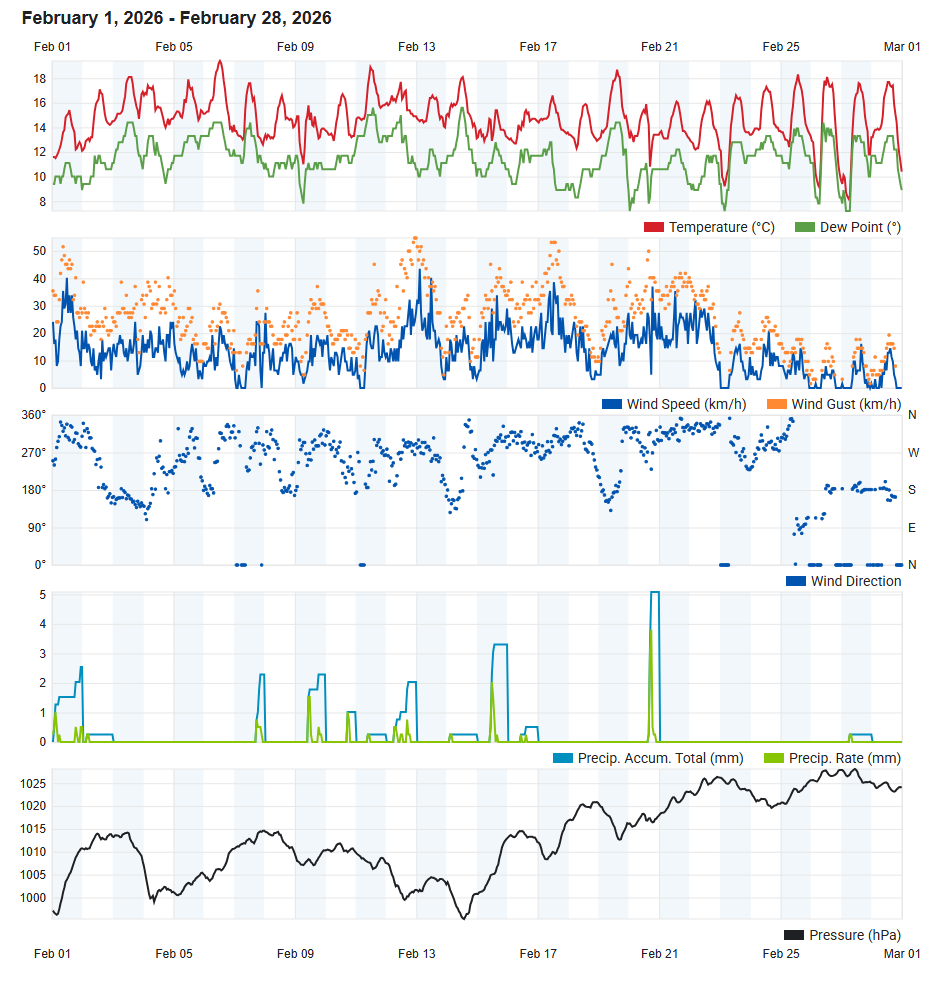
Windy but Surprisingly Warm and Dry in February 2026

Air Temperature

Highest Maximum 19.4°C 6th
Lowest Maximum 15.4°C 15th and 16th
Highest Minimum 14.7°C 12th
Lowest Minimum 8.0°C 27th


Mean Maximum 17.1°C
Mean Minimum 12.1°C
Mean 14.6°C


Relative Humidity

Highest Relative Humidity 95% Numerous days
Lowest Relative Humidity 63% 17th


Mean Relative Humidity 82.3%


Wind

Highest Gust 54.7km/h 12th


Days with Force 5 (29 – 38kph) 7 days
Days with Force 6 (39 – 49kph) 9 days
Days with Force 7 (50 – 61kph) 2 days
Days with Force 8 (62 – 74kph) 3 days
Days with Force 9 (75 – 88kph) 0 days
Days with Force 10+ (89kph+) 0 days


Mean Wind Speed 15.1km/h
Most Frequent Wind Direction West


Atmospheric Pressure

Highest Atmospheric Pressure 1028.1hPa 27th
Lowest Atmospheric Pressure 995.2hPa 14th


Mean Atmospheric Pressure 1013.2hPa


Precipitation

Total Rainfall During February 2026 26.5 mm
Total Rainfall Since Last 01/09 482.5 mm


Highest 24 Hour Total 7.0 mm 20th


Rain Days 11 days
Thunderstorm Days 1 day
Hail Days 1 day


Rainfall Events

01/02/2026 2.5 mm Isolated Showers
02/02/2026 0.3 mm Morning Isolated Light Rain
07/02/2026 3.2 mm Afternoon and Evening Light Rain
08/02/2026 0.0 mm Distant Isolated Light Rain
09/02/2026 3.2 mm Isolated Showers
10/02/2026 1.6 mm Afternoon Light Rain
11/02/2026 0.3 mm Isolated Light Rain
12/02/2026 2.0 mm Isolated Showers with Hail
14/02/2026 0.3 mm Morning Isolated Light Rain; Airborne Dust
15/02/2026 5.6 mm Steady Light Rain
16/02/2026 0.5 mm Isolated Showers
17/02/2026 0.0 mm Distant Isolated Light Rain
20/02/2026 7.0 mm Steady Rain; Distant Thunder


February 2026 Compared to the Climate Means

  Climate Mean February 2026 Anomaly
Mean Maximum Temperature 15.6°C 17.1°C  +1.5°C
Mean Minimum Temperature 9.7°C 12.1°C +2.4°C
Mean Temperature 12.7°C 14.6°C +1.9°C
Mean Relative Humidity 78.3% 82.3% +4.0%
Mean Atmospheric Pressure 1020.2hPa 1013.2hPa -7.0hPa
Total Rainfall 61.9 mm 26.5 mm -35.4 mm
Total Rainfall Since Last 01/09 447.5 mm 482.5 mm +35.0 mm
Total Rain Days 11 days 11 days /
Total Thunderstorm Days 3 days 1 day -2 days
Total Hail Days 2 days 1 day -1 day


Windy but Surprisingly Warm and Dry in February 2026

February 2026 continued the winter’s anomalously mild pattern across the Maltese Islands, though in sharp contrast to January it was significantly drier than average. The month was characterized by elevated temperatures, frequent westerly winds, suppressed rainfall totals, and persistently below-normal atmospheric pressure.

The mean air temperature clocked in at 14.6°C, which is 1.9°C above the climatological norm – an even stronger positive anomaly than January. Both daytime and night-time values reflected this. The mean maximum temperature stood at 17.1°C (+1.5°C), while the mean minimum rounded off at 12.1°C, a notable +2.4°C anomaly. The particularly strong elevation in minimum temperatures indicates sustained cloud cover and moist boundary-layer conditions limiting nocturnal cooling. The warmest day occurred on the 6th (19.4°C), while the lowest minimum of 8.0°C was recorded on the 27th during a brief anticyclonic interval.

Relative humidity averaged 82.3%, exceeding the long-term mean by 4.0%, reinforcing the impression of a persistently moist lower troposphere. Atmospheric pressure averaged 1013.2 hPa, which is 7.0 hPa below normal, confirming that cyclonic systems and Atlantic-derived disturbances remained influential across the central Mediterranean. Pressure ranged from 1028.1 hPa on the 27th – coinciding with the coolest minimum – to a deep 995.2 hPa on the 14th.

Wind conditions were a defining feature of the month. The most frequent wind direction was west, signaling a shift from January’s southeasterly dominance toward a more Atlantic-driven regime. Mean wind speed was 15.1 km/h, but several days experienced moderate to strong winds. Seven days recorded Force 5 winds, nine days Force 6, two days Force 7, and three days reached Force 8. The frequency of Force 6–8 days highlights a dynamically active month with repeated frontal passages.

Despite the active synoptic environment, rainfall totals were markedly suppressed. Only 26.5 mm of precipitation was measured, representing a deficit of 35.4 mm compared to the February mean of 61.9 mm. Rain fell on 11 days – consistent with climatological norms – but events were generally light and short-lived. The highest 24-hour total was just 7.0 mm on the 20th during a period of steady rain with distant thunder. Only one thunderstorm day and one hail day were recorded, both below average.

The rainfall regime suggests that while frontal systems affected the islands, they were either moisture-limited, fast-moving, or poorly organized locally. The predominance of a westerly flow may also have reduced orographic enhancement compared to January’s southeasterly episodes. Spatially, rainfall remained modest across the archipelago. The national mean was 21.1 mm, with slightly higher accumulations in Żurrieq (30.5 mm), Marsalforn (32.1 mm), and Imqabba (28.9 mm), and lower totals in Valletta (12.9 mm), Buġibba (13.4 mm), and Mosta (13.5 mm). The distribution was relatively even overall, reflecting the absence of prolonged convective or orographically enhanced events.

Although February itself was dry, cumulative rainfall since 1 September now stands at 482.5 mm, placing the hydrological season 35.0 mm above average by month’s end. This indicates that January’s surplus has more than compensated for February’s deficit.
Rainfall Totals around the Maltese Islands in February 2026 (and since last September 1st):

Kerċem: 26.5 mm (482.5 mm)

Victoria: 23.8 mm (485.9 mm)

Marsalforn: 32.1 mm (433.6 mm)

Xewkija: 15.7 mm (417.4 mm)

Nadur: 24.0 mm (433.8 mm)

Għajnsielem: 27.7 mm (436.7 mm)

Mellieħa: 18.9 mm (313.2 mm)

Buġibba: 13.4 mm (291.6 mm)

Mġarr: 21.9 mm (421.9 mm)

Naxxar: 18.3 mm (360.8 mm)

Mosta: 13.5 mm (329.2 mm)

Dingli: 15.7 mm (489.5 mm)

Pembroke: 23.0 mm (379.5 mm)

Msida: 19.0 mm (393.6 mm)

Sliema: 19.8 mm (395.9 mm)

Valletta: 12.9 mm (365.6 mm)

Fgura: 23.5 mm (396.9 mm)

Żejtun: 16.4 mm (365.7 mm)

Żabbar: 19.1 mm (335.9 mm)

Imqabba: 28.9 mm (478.0 mm)

Siġġiewi: 26.2 mm (481.4 mm)

Żurrieq: 30.5 mm (486.7 mm)

Marsaxlokk: 17.8 mm (332.0 mm)

NATIONAL MEAN: 21.1 mm (403.3 mm)
End of Month Reports

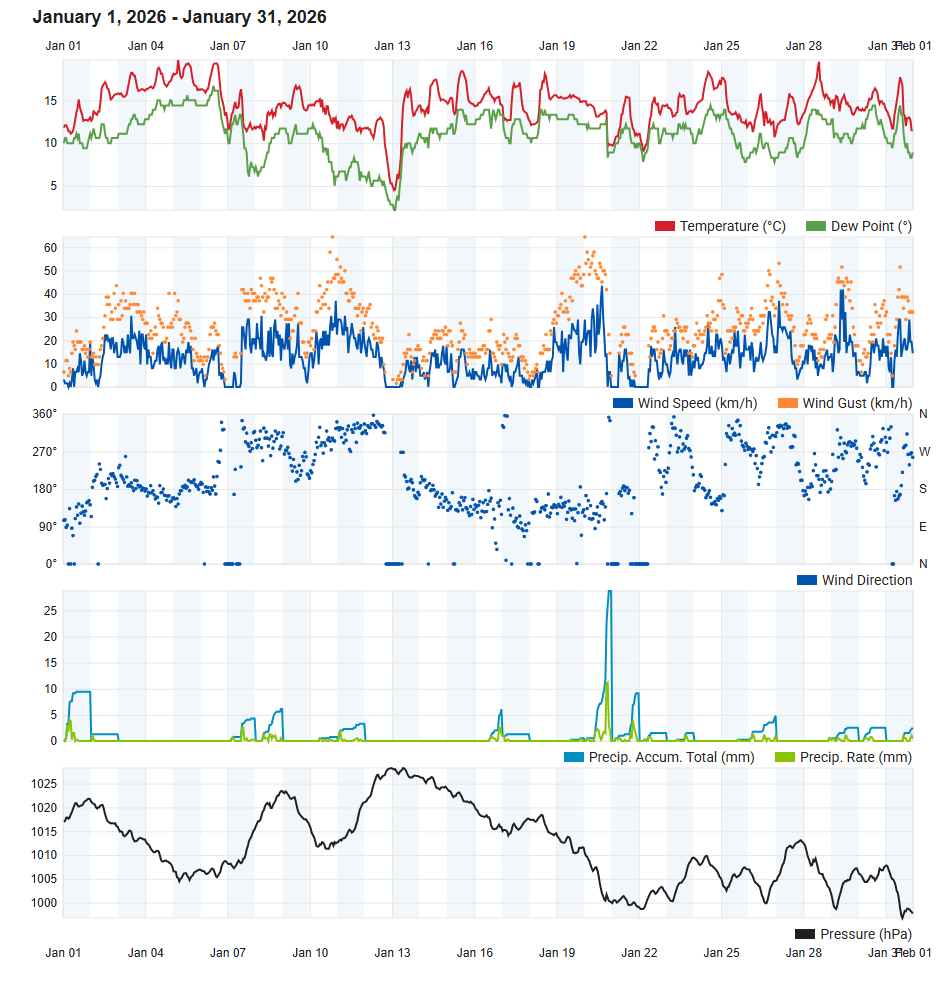
January 2026 brings Significant Rainfall and Storm Harry

Air Temperature

Highest Maximum 19.7°C 5th
Lowest Maximum 13.0°C 12th
Highest Minimum 16.1°C 5th
Lowest Minimum 4.1°C 13th


Mean Maximum 16.6°C
Mean Minimum 11.5°C
Mean 14.1°C


Relative Humidity

Highest Relative Humidity 95% Numerous days
Lowest Relative Humidity 59% 10th


Mean Relative Humidity 82.0%


Wind

Highest Gust 64.4km/h 20th


Mean Wind Speed 14.8km/h
Most Frequent Wind Direction Southeast


Atmospheric Pressure

Highest Atmospheric Pressure 1028.3hPa 13th
Lowest Atmospheric Pressure 996.3hPa 31st


Mean Atmospheric Pressure 1011.8hPa


Precipitation

Total Rainfall During January 2026 111.9 mm
Total Rainfall Since Last 01/09 456.0 mm


Highest 24 Hour Total 37.1 mm 20th


Rain Days 19 days
Thunderstorm Days 2 days
Hail Days 7 days


Rainfall Events

01/01/2026 14.3 mm Morning Periods of Rain
02/01/2026 1.8 mm Isolated Shower
07/01/2026 5.9 mm Afternoon and Evening Gusty Rain and Hail Showers
08/01/2026 8.4 mm Morning and Afternoon Gusty Rain and Hail Showers
10/01/2026 0.8 mm Evening Isolated Showers
11/01/2026 3.3 mm Gusty Rain and Hail Showers
12/01/2026 0.0 mm Distant Isolated Light Rain
16/01/2026 9.2 mm Steady Light Rain; Evening Thundery Rain and Hail Showers
17/01/2026 1.9 mm Morning Steady Light Rain; Distant Hailstorm
19/01/2026 1.1 mm Isolated Showers
20/01/2026 37.1 mm Steady Light Rain; Evening Heavy Thunderstorm with Hail
21/01/2026 11.8 mm Isolated Light Rain; Evening Steady Rain
22/01/2026 1.5 mm Morning Isolated Showers
23/01/2026 1.5 mm Isolated Showers
25/01/2026 0.3 mm Isolated Light Rain; Distant Steady Light Rain
26/01/2026 4.8 mm Showers
27/01/2026 0.0 mm Distant Isolated Showers
28/01/2026 0.5 mm Isolated Light Rain
29/01/2026 2.5 mm Isolated Showers
30/01/2026 2.7 mm Isolated Showers
31/01/2026 2.5 mm Isolated Showers; Distant Hail


January 2026 Compared to the Climate Means

  Climate Mean January 2026 Anomaly
Mean Maximum Temperature 15.6°C 16.6°C  +1.0°C
Mean Minimum Temperature 10.1°C 11.5°C +1.4°C
Mean Temperature 12.8°C 14.1°C +1.3°C
Mean Relative Humidity 78.4% 82.0% +3.6%
Mean Atmospheric Pressure 1021.7hPa 1011.8hPa -9.9hPa
Total Rainfall 69.4 mm 111.9 mm +42.5 mm
Total Rainfall Since Last 01/09 385.5 mm 456.0 mm +70.5 mm
Total Rain Days 14 days 19 days +5 days
Total Thunderstorm Days 4 days 2 days -2 days
Total Hail Days 2 days 7 days +5 days


January 2026 brings Significant Rainfall and Storm Harry

January 2026 was characterized by anomalously mild, humid and wet conditions. The mean air temperature, at 14.1°C, was 1.3°C above the climatological norm. This anomaly is evident in both daytime and night-time values, with a mean maximum of 16.6°C (+1.0°C) and a mean minimum of 11.5°C (+1.4°C). The warmest day occurred on the 5th (19.7°C), while the lowest minimum of the month, 4.1°C, was recorded on the 13th during a brief clearer and calmer interval.

The month was persistently moist, with mean relative humidity averaging 82%, above the long-term mean. Atmospheric pressure averaged 1011.8 hPa, a substantial 9.9 hPa below normal, reflecting frequent cyclonic incursions across the central Mediterranean and reduced anticyclonic dominance. Pressure ranged from 1028.3 hPa on the 13th to a deep 996.3 hPa on the 31st. Winds were predominantly southeasterly, with a mean speed of 14.8 km/h and a peak gust of 64.4 km/h on the 20th, consistent with repeated pre-frontal and warm-sector airflow episodes transporting moist maritime air towards the islands.

Rainfall was significantly above average. A total of 111.9 mm was measured during the month, exceeding the climate mean by 42.5 mm, while 19 rainy days were recorded – five more than normal. Since 1st September, cumulative rainfall reached 456.0 mm, confirming a wetter-than-average hydrological season to date. Spatially, precipitation totals were highest across western and elevated localities, including Mġarr (186.9 mm), Dingli (176.6 mm) and Żurrieq (166.6 mm), suggesting orographic enhancement under prevailing moist southeasterly flow. Lower totals were observed in more sheltered coastal areas such as Marsaxlokk (101.0 mm).

Two notable convective events headlined the month. On 17th January, an unusually intense hailstorm affected parts of Malta, particularly Rabat, where deep hail accumulations and localized drifts were reported. The event was associated with strong convection within a moist, unstable air mass enhanced by a relatively low freezing level and steep lapse rates, enabling efficient hail growth. Such accumulation events are rare in the Maltese Islands and indicative of vigorous updraft dynamics.

More significant was the passage of Storm Harry on 19th and 20th January, when a deep Mediterranean low developed within a broader European windstorm pattern. The system brought sustained strong southeasterly winds, heavy rainfall, thunderstorms and hail. On the 20th alone, 37.1 mm of rain was recorded — the highest 24-hour total of the month — alongside the strongest wind gust (64.4 km/h). Wind gusts of up to 100km/h were registered by several meteorological stations across the archipelago. The storm generated rough seas, coastal impacts and widespread weather-related disruption. Synoptically, the event reflected a well-developed pressure gradient and strong moisture advection ahead of the low centre, followed by the passage of a convectively active front.

Although only two thunderstorm days were recorded (below average), hail was observed on seven days, significantly above the climatological norm, indicating repeated episodes of cold upper-air intrusions and convective instability embedded within larger-scale disturbances.

Rainfall Totals around the Maltese Islands in January 2026 (and since last September 1st):

Kerċem: 111.9 mm (456.0 mm)

Victoria: 118.9 mm (462.1 mm)

Marsalforn: 103.7 mm (401.5 mm)

Xewkija: 104.1 mm (401.7 mm)

Nadur: 116.2 mm (409.8 mm)

Għajnsielem: 106.2 mm (409.0 mm)

Mellieħa: 127.6 mm (294.3 mm)

Buġibba: 107.5 mm (278.2 mm)

Mġarr: 186.9 mm (400.0 mm)

Naxxar: 134.7 mm (342.5 mm)

Mosta: 131.1 mm (315.7 mm)

Dingli: 176.6 mm (473.8 mm)

Pembroke: 116.4 mm (356.5 mm)

Msida: 116.4 mm (374.6 mm)

Sliema: 128.5 mm (376.1 mm)

Valletta: 109.1 mm (352.7 mm)

Fgura: 130.1 mm (373.4 mm)

Żejtun: 120.4 mm (349.3 mm)

Żabbar: 117.3 mm (316.8 mm)

Imqabba: 146.2 mm (449.1 mm)

Siġġiewi: 153.9 mm (455.2 mm)

Żurrieq: 166.6 mm (456.2 mm)

Marsaxlokk: 101.0 mm (314.2 mm)

NATIONAL MEAN: 126.0 mm (382.2 mm)

End of Month Reports

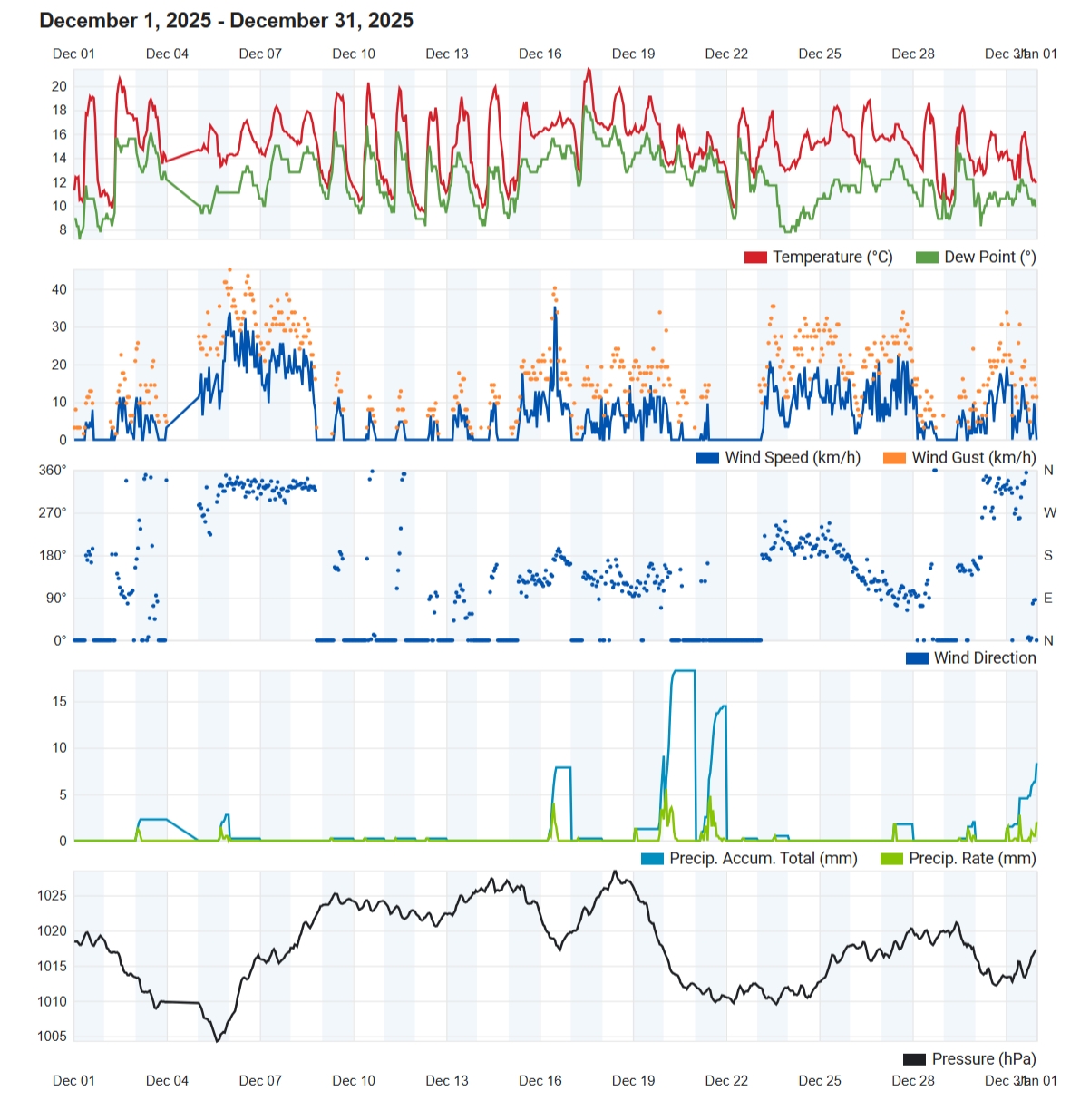
Plentiful Rain, High Humidity and a Dominance of Southerly Winds in December 2025

Air Temperature

Highest Maximum 21.4°C 17th
Lowest Maximum 16.1°C 30th
Highest Minimum 15.7°C 18th
Lowest Minimum 9.1°C 12th


Mean Maximum 18.3°C
Mean Minimum 12.0°C
Mean 14.9°C


Relative Humidity

Highest Relative Humidity 96% Numerous days
Lowest Relative Humidity 56% 1st


Mean Relative Humidity 84.2%


Wind

Highest Gust 45.1km/h 6th


Mean Wind Speed 8.0km/h
Most Frequent Wind Direction Southeast


Atmospheric Pressure

Highest Atmospheric Pressure 1028.5hPa 18th
Lowest Atmospheric Pressure 1004.1hPa 4th


Mean Atmospheric Pressure 1017.8hPa


Precipitation

Total Rainfall During December 2025 109.1 mm
Total Rainfall Since Last 01/09 344.1 mm


Highest 24 Hour Total 25.5 mm 20th


Rain Days 12 days
Thunderstorm Days 3 days
Hail Days 3 days


Rainfall Events

03/12/2025 5.4 mm Morning Rain
04/12/2025 8.8 mm Rainy; Isolated Rain/Hail Showers; Distant Thunder
05/12/2025 6.0 mm Rainy; Distant Hailstorm; Distant Thunder
06/12/2025 0.0 mm Distant Isolated Shower
09/12/2025 0.3 mm Heavy Dewfall
10/12/2025 0.3 mm Heavy Dewfall
11/12/2025 0.3 mm Heavy Dewfall; Distant Localized Morning Downpour
12/12/2025 0.3 mm Heavy Dewfall
16/12/2025 10.6 mm Morning Steady Rain
19/12/2025 12.7 mm Morning Isolated Showers; Evening Steady Rain
20/12/2025 25.5 mm Morning Steady Rain
21/12/2025 19.4 mm Periods of Rain
22/12/2025 0.3 mm Evening Isolated Shower
23/12/2025 0.5 mm Isolated Showers
24/12/2025 TR mm Drizzle; Distant Evening Isolated Showers
25/12/2025 0.0 mm Distant Morning Isolated Showers
27/12/2025 2.9 mm Isolated Showers
29/12/2025 3.3 mm Isolated Showers
31/12/2025 12.5 mm Thunderstorms; Rain/Hail Showers; Distant Hailstorm


December 2025 Compared to the Climate Means

  Climate Mean December 2025 Anomaly
Mean Maximum Temperature 17.2°C 18.3°C  +1.1°C
Mean Minimum Temperature 11.9°C 12.0°C +0.1°C
Mean Temperature 14.5°C 14.9°C +0.4°C
Mean Relative Humidity 78.9% 84.2% +5.3%
Mean Atmospheric Pressure 1018.0hPa 1017.8hPa -0.2hPa
Total Rainfall 83.0 mm 109.1 mm +26.1 mm
Total Rainfall Since Last 01/09 317.0 mm 344.1 mm +27.1 mm
Total Rain Days 13 days 12 days -1 day
Total Thunderstorm Days 3 days 3 days /
Total Hail Days 2 days 3 days +1 day


Plentiful Rain, High Humidity and a Dominance of Southerly Winds in December 2025

December 2025 was the first one in eleven years to bring more rainfall than the climate norm to our shores. A total of 109.1 mm was measured by our weather station. There were 12 days of measurable precipitation (> 0.1 mm) last month. Four of these, around mid-month, were the result of heavy dewfall under anticyclonic conditions. Another one was a mere drizzle on Christmas Eve. Last month’s rainfall was the product of three main weather systems: towards the beginning of the month, in the week before Christmas and the closing days of the year. Hailstorms on the 5th and the 31st were the month’s highlights. Central Malta was the hardest hit on both occasions.

A southeasterly (Scirocco) wind dominated the month. A staggering 15 days featured winds from the southeasterly quadrant (East Southeast, Southeast and South Southeast). With an overall value of 84.2%, overall levels of relative humidity reflected this reality. Standing at a mean of 18.3°C, maximum temperatures exceeded the climate norm by a significant 1.1°C. It is a direct result of warm air being advected to the central Mediterranean from north Africa. Mean minimum temperatures, on the other hand, were only a fraction of a degree above the typical value for the time of year. This could also be attributed to the cooling effect of elevated humidity levels and abundant soil moisture. The abscence of cold air incursions from northern Europe, however, meant that even the coldest night last month registered a mild minimum temperature of 9.1°C. The state of affairs would normally have cooled down substantially by the end of the year.

Another observation worth noting was the lack of exceptionally strong winds. No days with a sustained wind speed of Force 7 + were recorded last month. Northwesterly gales normally feature quite prominanelty in the first month of meteorological winter. Systems responsible for these gales were overpowered by more vigorous zones of low pressure emerging from north Africa.

Rainfall Totals around the Maltese Islands in December 2025 (and since last December 1st):

Kerċem: 109.1 mm (344.1 mm)

Victoria: 103.1 mm (343.2 mm)

Marsalforn: 92.3 mm (297.8 mm)

Xewkija: 80.0 mm (297.6 mm)

Nadur: 83.7 mm (293.6 mm)

Għajnsielem: 71.3 mm (302.8 mm)

Mellieħa: 88.7 mm (166.7 mm)

Buġibba: 85.4 mm (170.7 mm)

Mġarr: 123.6 mm (213.1 mm)

Naxxar: 111.6 mm (207.8 mm)

Mosta: 105.6 mm (184.6 mm)

Dingli: 115.9 mm (297.2 mm)

Pembroke: 97.0 mm (240.0 mm)

Msida: 99.1 mm (258.2 mm)

Sliema: 106.7 mm (247.6 mm)

Valletta: 97.3 mm (243.6 mm)

Fgura: 114.1 mm (243.3 mm)

Żejtun: 100.3 mm (228.9 mm)

Żabbar: 101.7 mm (199.5 mm)

Imqabba: 111.8 mm (302.9 mm)

Siġġiewi: 116.2 mm (301.3 mm)

Żurrieq: 110.2 mm (289.6 mm)

Marsaxlokk: 97.8 mm (213.2 mm)

NATIONAL MEAN: 100.4 mm (256.2 mm)

End of Month Reports

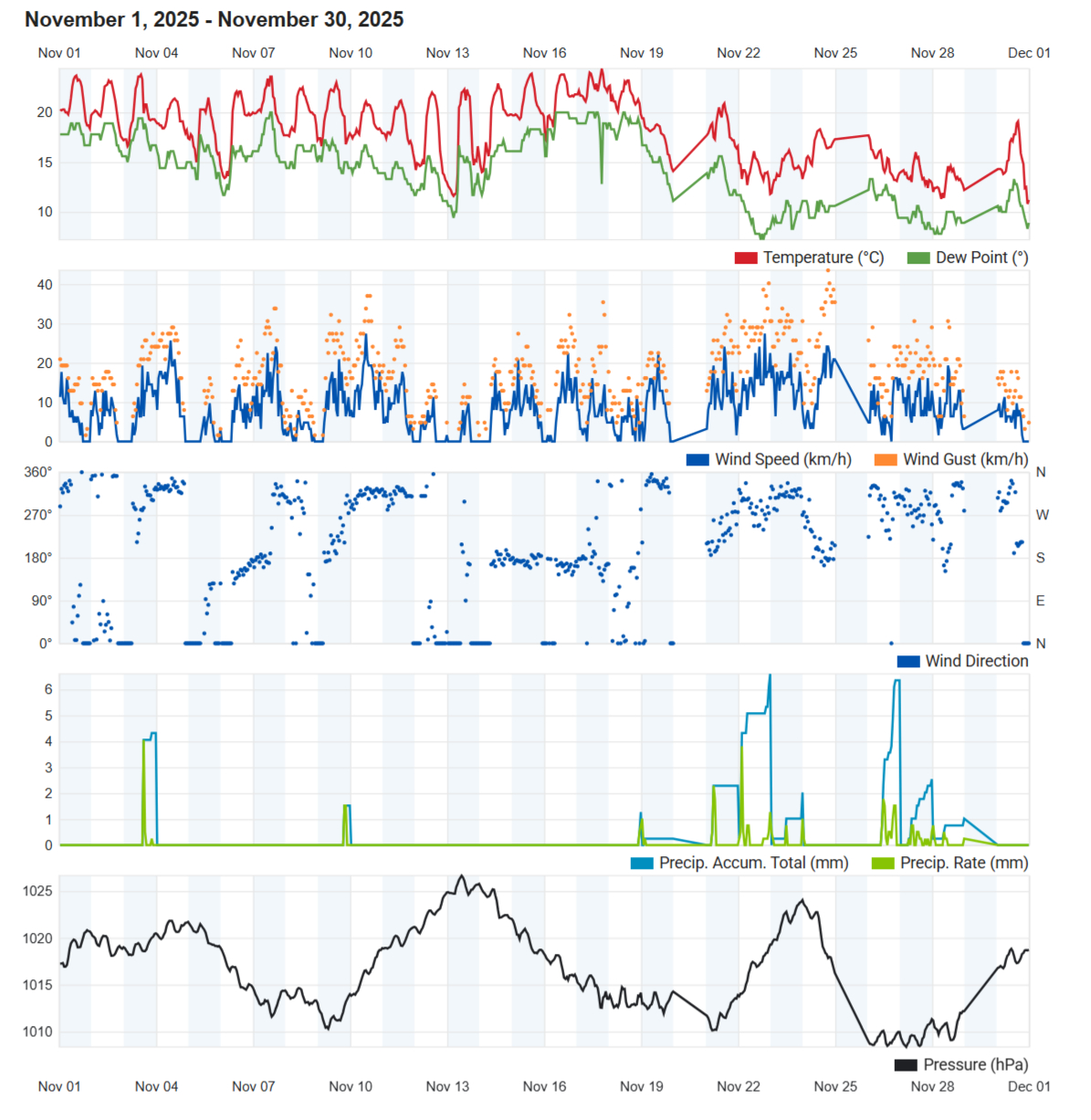
Drier than Average in November 2025

Air Temperature

Highest Maximum 24.4°C 17th
Lowest Maximum 14.6°C 28th
Highest Minimum 20.8°C 17th
Lowest Minimum 10.4°C 30th


Mean Maximum 20.9°C
Mean Minimum 14.6°C
Mean 17.9°C


Relative Humidity

Highest Relative Humidity 94% Numerous days
Lowest Relative Humidity 42% 17th


Mean Relative Humidity 79.3%


Wind

Highest Gust 43.5km/h 24th


Mean Wind Speed 9.4km/h
Most Frequent Wind Direction West Northwest


Atmospheric Pressure

Highest Atmospheric Pressure 1026.7hPa 13th
Lowest Atmospheric Pressure 1008.3hPa 27th


Mean Atmospheric Pressure 1016.8hPa


Precipitation

Total Rainfall During November 2025 35.1 mm
Total Rainfall Since Last 01/09 235.0 mm


Highest 24 Hour Total 10.3 mm 26th


Rain Days 11 days
Thunderstorm Days 2 days
Hail Days 3 days


Rainfall Events

01/11/2025 0.0 mm Distant Isolated Showers
02/11/2025 0.0 mm Distant Isolated Showers
03/11/2025 4.3 mm Isolated Showers
07/11/2025 0.0 mm Distant Downpours
09/11/2025 1.5 mm Isolated Showers
10/11/2025 0.0 mm Distant Isolated Showers
18/11/2025 1.5 mm Evening Light Rain
19/11/2025 0.3 mm Morning Light Rain
21/11/2025 2.6 mm Morning Shower
22/11/2025 7.6 mm Morning and Evening Rain/Hail Showers
23/11/2025 2.3 mm Isolated Showers
24/11/2025 0.0 mm Distant Light Rain
26/11/2025 10.3 mm Periods of Rain; Distant Lightning
27/11/2025 3.4 mm Rain/Hail Showers with Thunder; Distant Hailstorms
28/11/2025 1.0 mm Isolated Light Rain; Distant Rain/Hail Showers
29/11/2025 0.3 mm Morning Isolated Shower
30/11/2025 0.0 mm Distant Isolated Shower


November 2025 Compared to the Climate Means

  Climate Mean November 2025 Anomaly
Mean Maximum Temperature 20.9°C 20.9°C  /
Mean Minimum Temperature 15.2°C 14.6°C -0.6°C
Mean Temperature 18.0°C 17.9°C -0.1°C
Mean Relative Humidity 77.6% 79.3% -1.7%
Mean Atmospheric Pressure 1017.8hPa 1016.8hPa -1.0hPa
Total Rainfall 94.2 mm 35.1 mm -48.9 mm
Total Rainfall Since Last 01/09 234.0 mm 235.0 mm +1.0 mm
Total Rain Days 11 days 11 days /
Total Thunderstorm Days 5 days 2 days -3 days
Total Hail Days 1 day 3 days +2 days


Drier than Average in November 2025

Whilst days of instability dotted all of last month, and days of rain around the Maltese Islands exceeded the climate norm of 11 days, total precipitation was less than half the typical value for this month of the year. November, typically the year’s second wettest month, closed off with a poor national mean of 47.2 mm. This could be put down to the fact that most zones of instability failed to reach a prominent level of intensity. Also, most localities missed out on a handful of downpours which developed around us. From a regional perspective, November was a fairly typical month. Localities in Malta, particularly to the south, were the recipients of a downpour on the 7th and a hailstorm on the 27th. These two rainfall events are what made a difference for a handful of localities. Hail was observed on three days. It was large and in abundance on two occasions. This can be attributed to the earlier than usual advection of cold air from the north towards the central Mediterranean. Last month also helped narrow down the wide discrepancy in rainfall values between the two islands.

Temperatures were overall close to the norm in what is turning out to be a rather seasonal autumn. Colder than average nights were compensated for by typical daytime highs. The mean temperature of 17.9°C was a fraction of a degree cooler than the climate average. No temeprature extremes were recorded over the course of November 2025.

Rainfall Totals around the Maltese Islands in November 2025 (and since last November 1st):

Kerċem: 35.1 mm (235.0 mm)

Victoria: 37.6 mm (240.1 mm)

Marsalforn: 36.9 mm (205.5 mm)

Xewkija: 33.4 mm (217.6 mm)

Nadur: 30.8 mm (209.9 mm)

Għajnsielem: 33.6 mm (231.5 mm)

Mellieħa: 27.3 mm (78.0 mm)

Buġibba: 31.6 mm (85.3 mm)

Mġarr: 35.3 mm (89.5 mm)

Naxxar: 32.8 mm (96.2 mm)

Mosta: 29.2 mm (79.0 mm)

Dingli: 69.6 mm (181.3 mm)

Pembroke: 37.3 mm (143.1 mm)

Msida: 42.7 mm (159.1 mm)

Sliema: 43.7 mm (140.9 mm)

Valletta: 49.5 mm (146.3 mm)

Fgura: 64.6 mm (129.2 mm)

Żejtun: 78.1 mm (128.6 mm)

Żabbar: 43.8 mm (97.8 mm)

Imqabba: 92.9 mm (191.1 mm)

Siġġiewi: 94.8 mm (185.1 mm)

Żurrieq: 79.4 mm (179.4 mm)

Marsaxlokk: 46.0 mm (115.4 mm)

NATIONAL MEAN: 47.2 mm (155.8 mm)

End of Month Reports

Cooler than Average; Wetter in Gozo but Drier in Malta for October 2025

Air Temperature

Highest Maximum 27.4°C 26th
Lowest Maximum 22.3°C 3rd
Highest Minimum 20.8°C 22nd
Lowest Minimum 14.7°C 9th


Mean Maximum 24.4°C
Mean Minimum 18.0°C
Mean 21.1°C


Relative Humidity

Highest Relative Humidity 95% Numerous days
Lowest Relative Humidity 45% 7th


Mean Relative Humidity 77.7%


Wind

Highest Gust 53.1km/h 15th


Mean Wind Speed 11.1km/h
Most Frequent Wind Direction Northwest


Atmospheric Pressure

Highest Atmospheric Pressure 1025.7hPa 11th
Lowest Atmospheric Pressure 1010.4hPa 26th and 27th


Mean Atmospheric Pressure 1017.5hPa


Precipitation

Total Rainfall During October 2025 99.8 mm
Total Rainfall Since Last 01/09 199.9 mm


Highest 24 Hour Total 29.5 mm 13th


Rain Days 6 days
Thunderstorm Days 5 days
Hail Days 1 day


Rainfall Events

01/10/2025 18.0 mm Afternoon Thunderstorm; Evening Thundery Showers
02/10/2025 0.0 mm Morning Distant Isolated Showers
13/10/2025 29.5 mm Morning Thunderstorm
14/10/2025 0.8 mm Isolated Shower
15/10/2025 26.1 mm Afternoon Thunderstorm with Hail
16/10/2025 11.9 mm Morning Thunderstorm
18/10/2025 13.5 mm Steady Rain; Intermittent Evening Thunder
19/10/2025 0.0 mm Morning Distant Isolated Showers


October 2025 Compared to the Climate Means

  Climate Mean October 2025 Anomaly
Mean Maximum Temperature 24.9°C 24.4°C  -0.5°C
Mean Minimum Temperature 18.5°C 18.0°C -0.5°C
Mean Temperature 21.7°C 21.1°C -0.6°C
Mean Relative Humidity 77.7% 77.7% /
Mean Atmospheric Pressure 1017.8hPa 1017.5hPa -0.3hPa
Total Rainfall 84.0 mm 99.8 mm +15.8 mm
Total Rainfall Since Last 01/09 139.8 mm 199.9 mm +60.1 mm
Total Rain Days 10 days 6 days -4 days
Total Thunderstorm Days 6 days 5 days -1 day
Total Hail Days 1 day 1 day /


Cooler than Average; Wetter in Gozo but Drier in Malta for October 2025

October, the second month of meteorological autumn, was marked by a mean temperature 0.5°C below the climate norm. This margin was reflected in both mean maximum and mean minimum temperatures. Temperatures in Malta were notably warmer. This can be attributed to the cooling effect of the abundant autumn rain in Gozo. The surface runoff following the rainfall helps cool down the sea. The greater amount of moisture in the soil contributes to a higher humidity levels. Both help prevent the air from heating up too much. In fact, a warm spell towards the end of October registered a maximum temperature of 30°C + in Malta on the 26th. Gozo saw the temperature peak at a more comfortable 27.4°C on that same day.

October followed the rainfall pattern set in the previous month. Whilst Gozo closed off the month with a mean precipitation total of 82.1 mm, Malta lagged further behind with a tally of 62.5 mm. This discrepancy is compounded when taking into account totals since September 1st; Gozo’s tally standing at almost 200 mm with Malta less than half that at 78 mm! It is a well known fact in local meteorology that Gozo is often hit harder by autumn thunderstorms than Malta. Although with a difference of just a few kilometers, Gozo lies slightly further north and is therefore more exposed to incoming storm systems from the sea. Warm waters around the island help fuel storms, and its slightly higher, more open landscape can enhance their intensity. Storm tracks frequently pass over Gozo before reaching Malta, meaning storms may weaken by the time they hit the main island. To address a common misconception which has been floated about; while Malta’s more urbanized environment can slightly influence local wind patterns and heat, they don’t push storms away. Thunderstorms are driven by large-scale atmospheric forces, far stronger than anything urban areas can deflect. Historical data confirms that in years with a good autumn, Gozo often surpasses Malta in total rainfall. Conversely, in years with a poor autumn, Gozo often lags behind Malta. In winter and early spring, rainfall shifts to a more frontal origin. Malta, sitting slightly further south and east is more exposed to rain bands moving in from other directions. The 6 days of rain and 5 days on which thunder was heard are both short of the norm. This confirms that the fewer zones of instability which developed across the central Mediterranean were particularly intense.

Rainfall Totals around the Maltese Islands in October 2025 (and since last October 1st):

Kerċem: 99.8 mm (199.9 mm)

Victoria: 95.2 mm (202.5 mm)

Marsalforn: 84.4 mm (168.6 mm)

Xewkija: 68.8 mm (184.2 mm)

Nadur: 73.9 mm (179.1 mm)

Għajnsielem: 92.0 mm (197.9 mm)

Mellieħa: 30.3 mm (50.7 mm)

Buġibba: 38.0 mm (53.7 mm)

Mġarr: 47.6 mm (54.2 mm)

Naxxar: 45.5 mm (63.4 mm)

Mosta: 35.8 mm (49.8 mm)

Dingli: 100.3 mm (111.7 mm)

Pembroke: 77.3 mm (105.8 mm)

Msida: 91.8 mm (116.4 mm)

Sliema: 67.4 mm (97.2 mm)

Valletta: 63.1 mm (96.8 mm)

Fgura: 61.3 mm (64.6 mm)

Żejtun: 40.6 mm (50.5 mm)

Żabbar: 43.2 mm (54.0 mm)

Imqabba: 89.7 mm (98.2 mm)

Siġġiewi: 80.3 mm (90.3 mm)

Żurrieq: 89.1 mm (100.0 mm)

Marsaxlokk: 61.2 mm (69.4 mm)

NATIONAL MEAN: 68.2 mm (40.5 mm)

End of Month Reports

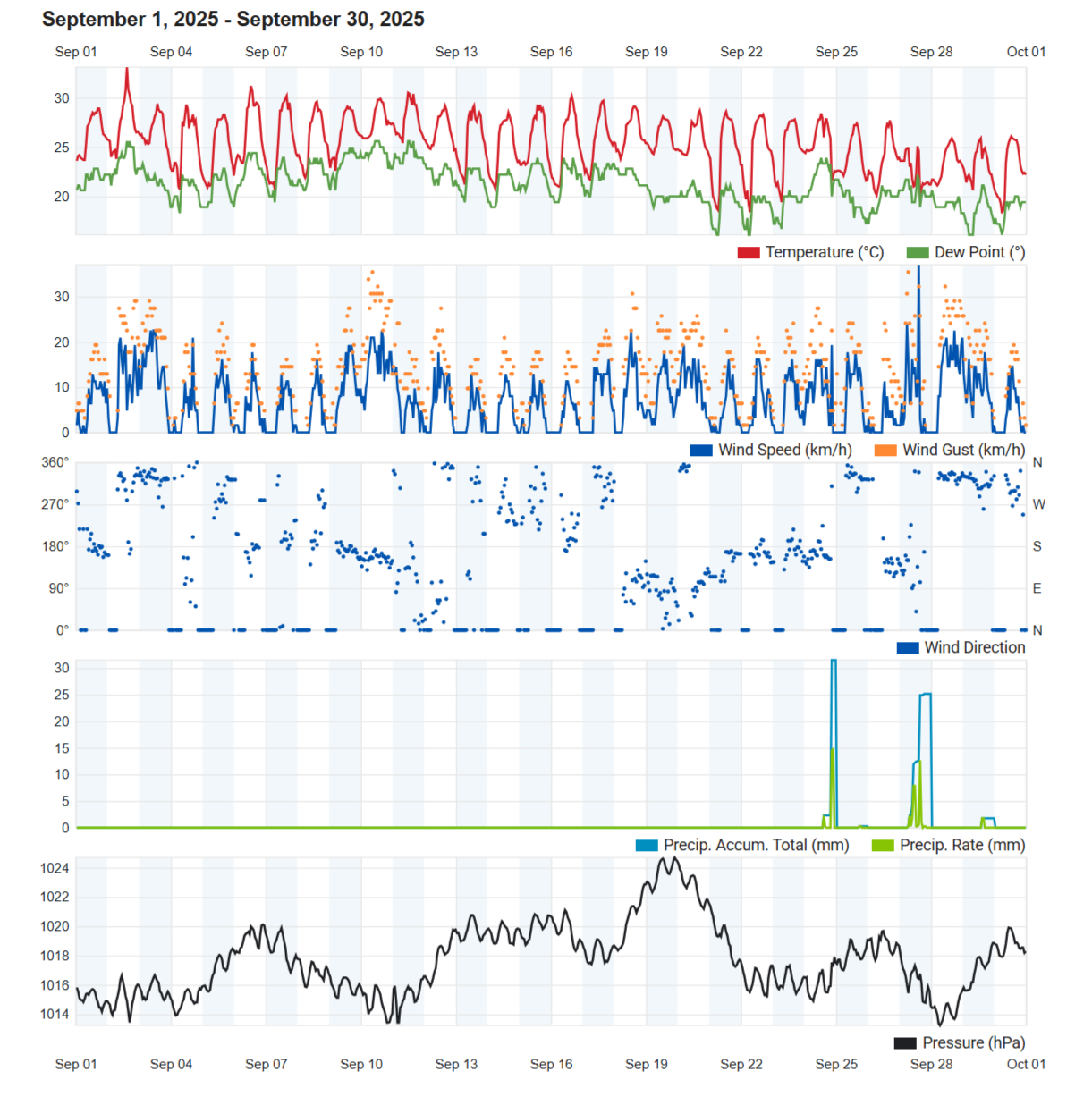
Wetter in Gozo but Drier in Malta in September 2025

Air Temperature

Highest Maximum 33.1°C 2nd
Lowest Maximum 25.1°C 27th
Highest Minimum 25.8°C 10th
Lowest Minimum 17.7°C 30th


Mean Maximum 28.8°C
Mean Minimum 21.4°C
Mean 25.1°C


Relative Humidity

Highest Relative Humidity 96% Numerous days
Lowest Relative Humidity 55% 2nd and 25th


Mean Relative Humidity 79.0%


Wind

Highest Gust 35.4km/h 10th


Mean Wind Speed 7.3km/h
Most Frequent Wind Direction South


Atmospheric Pressure

Highest Atmospheric Pressure 1024.7hPa 19th
Lowest Atmospheric Pressure 1012.4hPa 11th


Mean Atmospheric Pressure 1017.6hPa


Precipitation

Total Rainfall During September 2025 100.1 mm
Total Rainfall Since Last 01/09 100.1 mm


Highest 24 Hour Total 60.4 mm 24th


Rain Days 3 days
Thunderstorm Days 3 days
Hail Days 1 day


Rainfall Events

24/09/2025 60.4 mm Afternoon Isolated Thunderstorm; Evening Thunderstorm
26/09/2025 0.0 mm Distant Isolated Light Rain; Distant Thunder
27/09/2025 37.1 mm Morning Thunderstorm; Afternoon Thunderstorm with Hail
29/09/2025 2.6 mm Afternoon Isolated Shower


September 2025 Compared to the Climate Means

  Climate Mean September 2025 Anomaly
Mean Maximum Temperature 28.5°C 28.8°C  +0.3°C
Mean Minimum Temperature 21.6°C 21.4°C -0.2°C
Mean Temperature 25.0°C 25.1°C +0.1°C
Mean Relative Humidity 76.6% 79.0% +2.4%
Mean Atmospheric Pressure 1016.7hPa 1017.6hPa +0.9hPa
Total Rainfall 54.9 mm 100.1 mm +45.2 mm
Total Rainfall Since Last 01/09 54.9 mm 100.1 mm +45.2 mm
Total Rain Days 5 days 3 days -2 days
Total Thunderstorm Days 3 days 3 days /
Total Hail Days 0 days 1 day +1 day


Wetter in Gozo but Drier in Malta in September 2025

Temperatures in the first month of meteorological autumn were around average for the time of year. The mean temperature of 25.1°C was only a fraction of a degree above average. The slightly warmer days but slightly cooler nights contributed to this balance. The warmest day of the month, the 2nd, registered a maximum temperature 33.1°C. Temperatures declined gradually as the month progressed. Levels of relative humidity were overall higher than the norm, meaning realfeels were generally higher than the actual temperatures.

Precipitation patterns weren’t as straightforward. Last month was completely dry up until the 23rd. The first wave of autumn instability arrived late and lasted for much of the final week of September 2025. The 24th and the 27th were particularly stormy; producing 97.5 mm of the 100.1 mm measured at our Gozo weather station. Whilst Gozo experienced flash flooding in the usual localities on both days, Malta was left largely untouched by the heavy downpours on those days. Mean precipitation across Malta totalled 15.5 mm. This was very poor when compared to Gozo’s average of 103 mm. There were three rainy days. Thunder was heard on three days. Hail accompanied the afternoon thunderstorm on the 27th. The thunderstorm on the 27th brought a so-called ‘microburst’ (sudden torrential rain accompanied by strong wind) to localities across the southern half of Gozo.

September was marked by a notable absence of windy days, probably due to the intense high pressure which prevailed across the central Mediterranean for much of the month.

Rainfall Totals around the Maltese Islands in September 2025 (and since last September 1st):

Kerċem: 100.1 mm (100.1 mm)

Victoria: 107.3 mm (107.3 mm)

Marsalforn: 84.2 mm (84.2 mm)

Xewkija: 115.4 mm (115.4 mm)

Nadur: 105.2 mm (105.2 mm)

Għajnsielem: 105.9 mm (105.9 mm)

Mellieħa: 20.4 mm (20.4 mm)

Buġibba: 15.7 mm (15.7 mm)

Mġarr: 6.6 mm (6.6 mm)

Naxxar: 17.9 mm (17.9 mm)

Mosta: 14.0 mm (14.0 mm)

Dingli: 11.4 mm (11.4 mm)

Pembroke: 28.5 mm (28.5 mm)

Msida: 24.6 mm (24.6 mm)

Sliema: 29.8 mm (29,8 mm)

Valletta: 33.7 mm (33.7 mm)

Fgura: 3.3 mm (3.3 mm)

Żejtun: 9.9 mm (9.9 mm)

Żabbar: 10.8 mm (10.8 mm)

Imqabba: 8.5 mm (8.5 mm)

Siġġiewi: 10.0 mm (10.0 mm)

Żurrieq: 10.9 mm (10.9 mm)

Marsaxlokk: 8.2 mm (8.2 mm)

NATIONAL MEAN: 40.5 mm (40.5 mm)

End of Month Reports

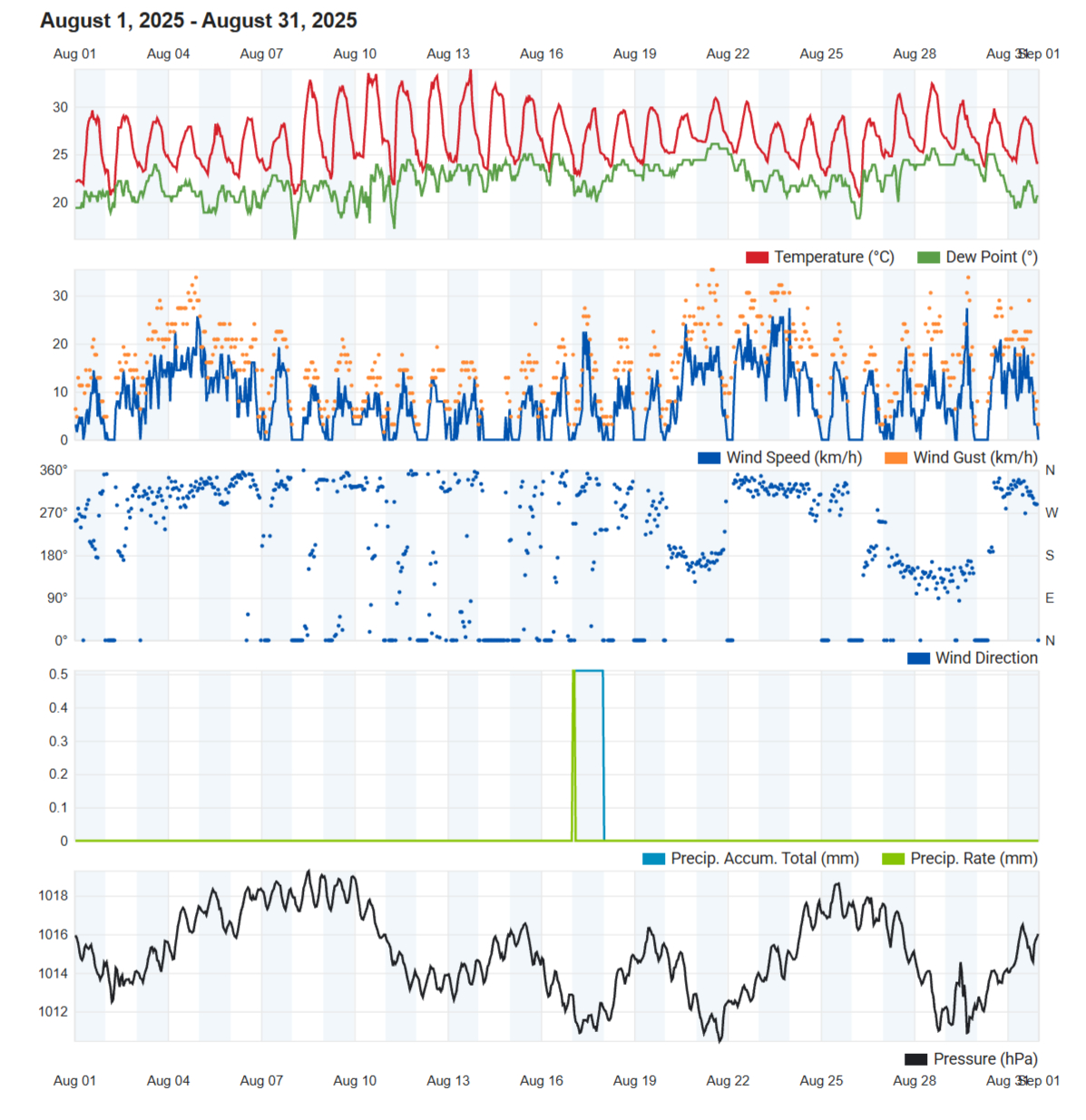
Cooler than Average in August 2025

Air Temperature

Highest Maximum 33.9°C 13th
Lowest Maximum 27.9°C 4th
Highest Minimum 26.2°C 21st
Lowest Minimum 19.8°C 2nd


Mean Maximum 30.3°C
Mean Minimum 23.0°C
Mean 26.7°C


Relative Humidity

Highest Relative Humidity 94% Numerous days
Lowest Relative Humidity 39% 27th


Mean Relative Humidity 78.1%


Wind

Highest Gust 35.4km/h 21st


Mean Wind Speed 8.6km/h
Most Frequent Wind Direction Northwest


Atmospheric Pressure

Highest Atmospheric Pressure 1019.3hPa 8th
Lowest Atmospheric Pressure 1010.2hPa 21st


Mean Atmospheric Pressure 1014.9hPa


Precipitation

Total Rainfall During August 2025 0.5 mm
Total Rainfall Since Last 01/09 503.9 mm


Highest 24 Hour Total 0.5 mm 17th


Rain Days 2 days
Thunderstorm Days 2 days
Hail Days 0 days


Rainfall Events

16/8/2025 0.0 mm Distant P.M. Thunderstorm
17/8/2025 0.5 mm A.M. Thunderstorm
29/8/2025 TR mm Isolated Light Rain


August 2025 Compared to the Climate Means

  Climate Mean August 2025 Anomaly
Mean Maximum Temperature 31.7°C 30.3°C  -1.4°C
Mean Minimum Temperature 23.3°C 23.0°C -0.3°C
Mean Temperature 27.5°C 26.7°C -0.8°C
Mean Relative Humidity 73.6% 78.1% +4.5%
Mean Atmospheric Pressure 1014.1hPa 1014.9hPa +0.8hPa
Total Rainfall 10.6 mm 0.5 mm -10.1 mm
Total Rainfall Since Last 01/09 529.4 mm 503.9 mm -25.5 mm
Total Rain Days 1 day 2 days +1 day
Total Thunderstorm Days 1 day 2 days +1 day
Total Hail Days 0 days 0 days /


Cooler than Average in August 2025

The third and final month of meteorological summer confirmed this year’s summer as a very forgiving one temperature-wise, but rather uncomfortable with regards to relative humidity. The mean temperature of 26.7°C stood 0.8°C below the average for this time of year. This was comprised by a mean maximum temperature of 30.3°C (1.4°C cooler than normal) and a mean minimum temperature of 23.0°C (0.3°C cooler than normal). Levels of relative humidity stood at an average of 78.1%. This made the cooler than average temperatures feel really warm. No intense heat spells were registered over the course of last month. In fact, the warmest day of the month registered a maximum temperature of ‘only’ 33.9°C. The elevated levels of relative humidity were due to a sea surface temperature which remained at 27°C + on the whole.

August was a mixed bag of spring weather. As spring settled in across the Maltese Islands, August was characterized by a mix of pleasant weather and occasional instability, including a day of intense thundery downpours. Despite the occasional unsettled spell, last month was warmer than average.

The days following the public holiday on the 15th lived up to their expectation of bringing to our shores some rain-bearing clouds. What started as a zone of instability over Sicily quickly spread south across the central Mediterranean. Two separate thunderstorms struck parts of the Maltese Islands; one in the afternoon hours of the 16th and another in the predawn hours of the 17th. Whilst only a measly 0.5 mm of rain was measured by our weather station in Gozo, several other localities registered greater rainfall amounts. Siġġiewi and Żurrieq, for instance, measured 56.4 mm and 42.2 mm respectively. Other localities around Malta recieved half an inch of rainfall. Gozo was less affected. The second thunderstorm, which struck in the dark hours, produced a beautiful display of lightning. On a separate occasion, southerly currents on the 29th brought with them overcast skies, a trace of rainfall and a dusting of desert sand.

Rainfall Totals around the Maltese Islands in August 2025 (and since last September 1st):

Kerċem: 0.5 mm (503.9 mm)

Victoria: 0.7 mm (521.0 mm)

Marsalforn: 0.0 mm (433.2 mm)

Xewkija: 0.0 mm (371.3 mm)

Nadur: 0.3 mm (484.6 mm)

Għajnsielem: 0.0 mm (421.0 mm)

Mellieħa: 6.4 mm (382.2 mm)

Buġibba: 8.9 mm (378.8 mm)

Mġarr: 18.5 mm (468.5 mm)

Naxxar: 16.0 mm (482.6 mm)

Mosta: 9.2 mm (469.4 mm)

Dingli: 0.0 mm (569.3 mm)

Pembroke: 11.4 mm (503.2 mm)

Msida: 24.7 mm (572.5 mm)

Sliema: 12.7 mm (462.3 mm)

Valletta: 20.0 mm (477.8 mm)

Fgura: 8.1 mm (555.5 mm)

Żejtun: 1.0 mm (500.2 mm)

Żabbar: 1.6 mm (553.8 mm)

Imqabba: 16.5 mm (545.6 mm)

Siġġiewi: 56.4 mm (542.1 mm)

Żurrieq: 42.2 mm (515.6 mm)

Marsaxlokk: 4.6 mm (388.4 mm)

NATIONAL MEAN: 10.9 mm (480.1 mm)

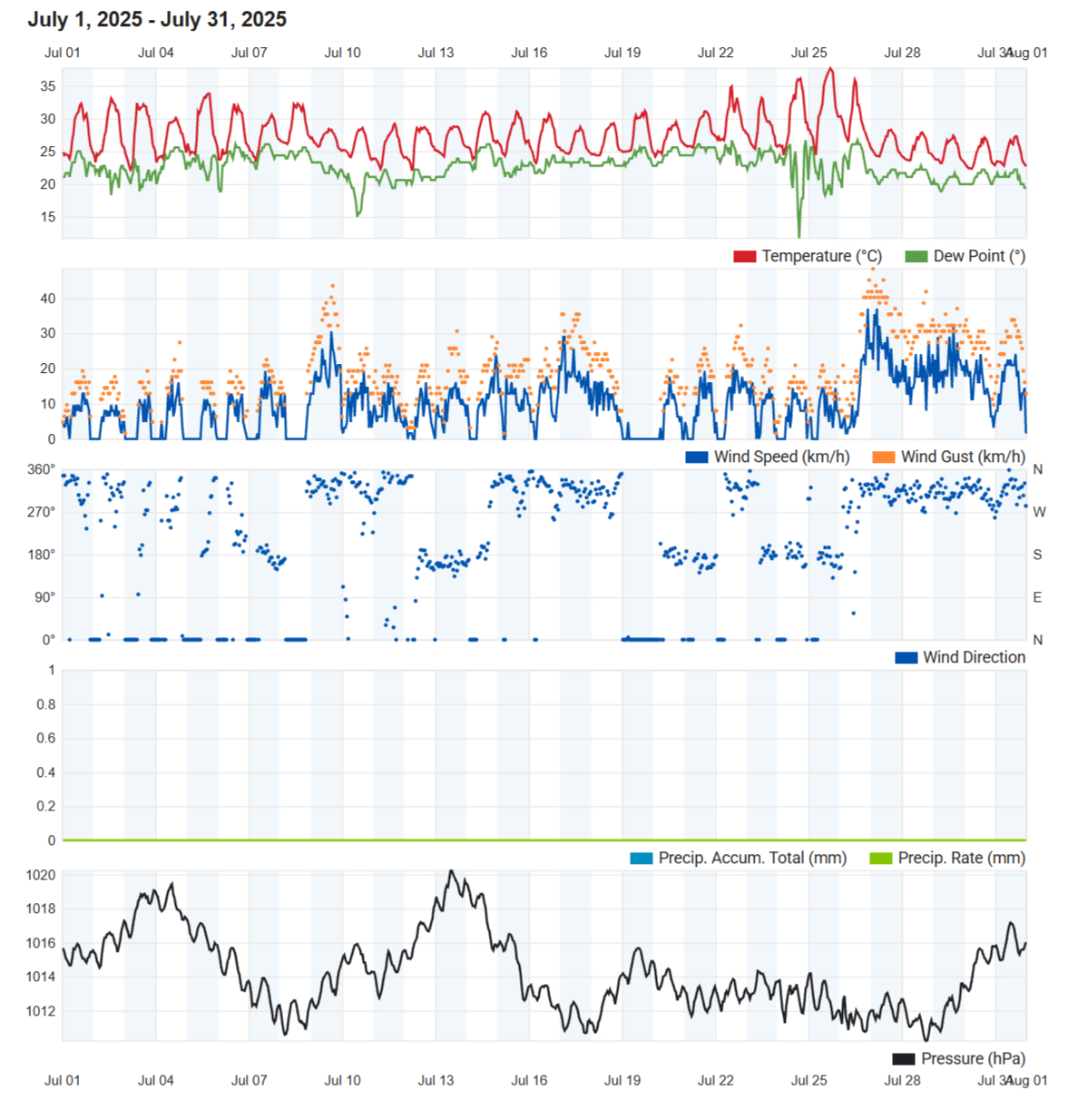
End of Month Reports

Cooler Days but Warmer Nights in July 2025

Air Temperature

Highest Maximum 37.7°C 25th
Lowest Maximum 27.1°C 27th
Highest Minimum 26.1°C 8th
Lowest Minimum 21.2°C 12th


Mean Maximum 30.9°C
Mean Minimum 23.6°C
Mean 27.3°C


Relative Humidity

Highest Relative Humidity 96% Numerous days
Lowest Relative Humidity 18% 24th


Mean Relative Humidity 77.4%


Wind

Highest Gust 48.3km/h 27th


Mean Wind Speed 10.7km/h
Most Frequent Wind Direction Northwest


Atmospheric Pressure

Highest Atmospheric Pressure 1020.2hPa 13th
Lowest Atmospheric Pressure 1010.1hPa 28th


Mean Atmospheric Pressure 1014.1hPa


Precipitation

Total Rainfall During July 2025 0.0 mm
Total Rainfall Since Last 01/09 503.4 mm


Highest 24 Hour Total / /


Rain Days 0 days
Thunderstorm Days 0 days
Hail Days 0 days


July 2025 Compared to the Climate Means

  Climate Mean July 2025 Anomaly
Mean Maximum Temperature 31.6°C 30.9°C  -0.7°C
Mean Minimum Temperature 22.5°C 23.6°C +1.1°C
Mean Temperature 27.0°C 27.3°C +0.3°C
Mean Relative Humidity 70.2% 77.4% +7.2%
Mean Atmospheric Pressure 1014.6hPa 1014.1hPa -0.5hPa
Total Rainfall 0.2 mm 0.0 mm -0.2 mm
Total Rainfall Since Last 01/09 514.7 mm 503.4 mm -11.3 mm
Total Rain Days 0 days 0 days /
Total Thunderstorm Days 0 days 0 days /
Total Hail Days 0 days 0 days /


Cooler Days but Warmer Nights in July 2025

Other than two heat spells; one towards the beginning and another towards the end, July was relatively merciful. The mean temperature last month was only 0.3°C above the climate norm of 27.0°C. Whilst the mean maximum temperature of 30.9°C was  0.7°C cooler than the norm, July’s mean minimum temperature of 23.6°C was 1.1°C warmer than average. This could be due to an elevated relative humidity. Levels of humidity averaged at 77.4%, a significant 7.2% over the climate norm. Elevated humidity prevents temperatures from shooting up during the day, but keeps them from cooling down at night. Despite the cooler maximum temperatures overall, real feels were generally uncomfortable, once again owing to the humidity levels. The main contributor to the greater humidity was the very warm sea. A downpour across parts of the Maltese Islands on the eve of summer solstice was also a contributing factor. Outbreaks of days with a breezy Northwesterly wind also ensured that temperatures didn’t get too hot for too long. The hottest day last month was the 25th, with the thermometers marking 37.7°C. Overall, values were typical of what one would expect from a Maltese summer.

July 2024 also lived up to its expectation of being a completely dry month. No rain made it to the Maltese Islands throughout. Some mist or fog patches were observed.

Rainfall Totals around the Maltese Islands in July 2025 (and since last September 1st):

Kerċem: 0.0 mm (503.4 mm)

Victoria: 0.0 mm (520.3 mm)

Marsalforn: 0.0 mm (433.2 mm)

Xewkija: 0.0 mm (371.3 mm)

Nadur: 0.0 mm (484.3 mm)

Għajnsielem: 0.0 mm (421.0 mm)

Mellieħa: 0.0 mm (375.8 mm)

Buġibba: 0.0 mm (369.9 mm)

Mġarr: 0.0 mm (450.0 mm)

Naxxar: 0.0 mm (466.6 mm)

Mosta: 0.0 mm (460.2 mm)

Dingli: 0.0 mm (569.3 mm)

Pembroke: 0.0 mm (491.8 mm)

Msida: 0.0 mm (547.8 mm)

Sliema: 0.0 mm (449.6 mm)

Valletta: 0.0 mm (457.8 mm)

Fgura: 0.0 mm (547.4 mm)

Żejtun: 0.0 mm (499.2 mm)

Żabbar: 0.0 mm (552.2 mm)

Imqabba: 0.0 mm (529.1 mm)

Siġġiewi: 0.0 mm (485.7 mm)

Żurrieq: 0.0 mm (473.4 mm)

Marsaxlokk: 0.0 mm (383.8 mm)

NATIONAL MEAN: 0.0 mm (469.2 mm)

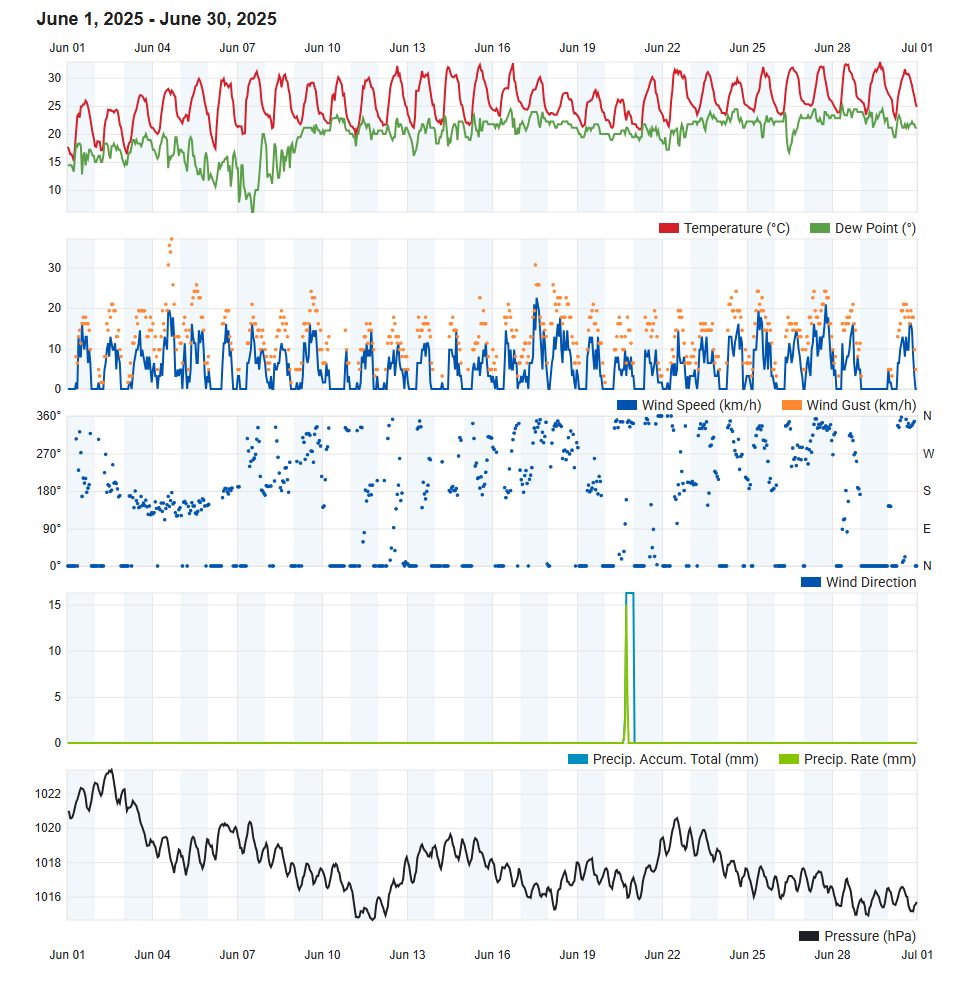
End of Month Reports

Warmer than Average in June 2025

Air Temperature

Highest Maximum 32.8°C 29th
Lowest Maximum 24.3°C 2nd
Highest Minimum 24.9°C 27th
Lowest Minimum 14.6°C 1st


Mean Maximum 30.1°C
Mean Minimum 20.8°C
Mean 25.4°C


Relative Humidity

Highest Relative Humidity 95% 20th
Lowest Relative Humidity 19% 6th


Mean Relative Humidity 71.9%


Wind

Highest Gust 37.0km/h 4th


Mean Wind Speed 5.8km/h
Most Frequent Wind Direction West Northwest


Atmospheric Pressure

Highest Atmospheric Pressure 1023.4hPa 2nd
Lowest Atmospheric Pressure 1014.4hPa 11th


Mean Atmospheric Pressure 1017.8hPa


Precipitation

Total Rainfall During June 2025 22.5 mm
Total Rainfall Since Last 01/09 503.4 mm


Highest 24 Hour Total 22.5 mm 20th


Rain Days 1 day
Thunderstorm Days 0 days
Hail Days 0 days


Rainfall Events

20/6/2025 22.5 mm P.M. Downpours


June 2025 Compared to the Climate Means

  Climate Mean June 2025 Anomaly
Mean Maximum Temperature 28.5°C 30.1°C  +1.6°C
Mean Minimum Temperature 19.8°C 20.8°C +1.0°C
Mean Temperature 24.2°C 25.4°C +1.2°C
Mean Relative Humidity 70.5% 71.9% +1.4%
Mean Atmospheric Pressure 1015.1hPa 1017.8hPa +2.7hPa
Total Rainfall 4.1 mm 22.5 mm +18.4 mm
Total Rainfall Since Last 01/09 518.6 mm 503.4 mm -15.2 mm
Total Rain Days 1 day 1 day /
Total Thunderstorm Days 1 day 0 days -1 day
Total Hail Days 0 days 0 days /


Warmer than Average in June 2025

 June was off to a comfortable start. This lasted only briefly, however, as the heat of summer quickly turned up on the 7th. From then on, temperatures were above the climatic norm of 24.2°C on 23 days out of 24. The single cooler day was the 20th, a day which brought a series of afternoon downpours to parts of the Maltese Islands, the heaviest of which struck Gozo. The 29th, a Sunday, was the warmest day last month. The temperature peaked at 32.8°C on the day. For comparison, the mean maximum temperature for June is of 28.5°C. The pre-dawn hours of the 1st day of the month were the coolest, with a minimum temperature of 14.6°C. June’s climatic mean minimum temperature of 19.8°C was exceeded by a total of 21 out of 30 nights.

Large swathes of western Europe were affected by a particularly intense heat wave, with temperature values regularly in the upper 40°Cs across Spain and Portugal. In addition to this, the entire Mediterranean basin experienced an incredible lack of wind, widespread calm sea and uninterrupted blazing sunshine for much of June. This means that transfer of heat from the Sun to the sea surface is uninterrupted. The lack of wind and waves means that the sea isn’t mixing. This leads to a build-up of heat in the topmost layer of the sea. When the sea warms up too much, marine ecosystems are negatively impacted. Several marine species are not adapted to the warmer waters and therefore will suffer from poor health if not die. The lifecycle of numerous marine species goes haywire, especially where reproduction is concerned. Furthermore, marine ecosystems (especially those in shallower waters) experience a degree of degradation. The rates of oxygen dissolved in the water will also vary more widely. Finally, some alien species find it easier to spread in warmer waters, threatening the existence of more indigenous marine life. A very high sea surface temperature inhibits nighttime cooling in air temperatures. The high sea surface temperature will also contribute to increased rates of evaporation, which in turn, will lead to increased humidity. The more humid the air is, the warmer and clammier it will feel. Early and late mist or fog patches are also products of these increased levels of humidity.

June brought with it one day of rain. Rainfall was in the form of localized downpours, over the central and northern coasts of both Malta and Gozo. Surprisingly, Gozo received the heaviest rainfall. Being the larger island, it is Malta that normally receives the most rainfall from these downpours. These clouds develop thanks to the vertical movement of columns of warm and humid air on sunny days and when the upper levels of the atmosphere are unstable due to the incursion of cold air from northern Europe. This is a process caused when the cold air in the upper levels of the atmosphere contrasts with the ground that has been well heated by the sun locally. This movement encourages the condensation of water vapor in this air and thus the formation of clouds. These showers, which affected only localized areas, lasted for a long while. Victoria, in Gozo, recorded up to 26.9 mm on that day. The national mean for the day, and also the month, was of 3.2 mm.

Rainfall Totals around the Maltese Islands in June 2025 (and since last September 1st):

Kerċem: 22.5 mm (503.4 mm)

Victoria: 26.9 mm (520.3 mm)

Marsalforn: 1.4 mm (433.2 mm)

Xewkija: 8.8 mm (371.3 mm)

Nadur: 1.2 mm (484.3 mm)

Għajnsielem: 0.0 mm (421.0 mm)

Mellieħa: 0.0 mm (375.8 mm)

Buġibba: 0.0 mm (369.9 mm)

Mġarr: 0.0 mm (450.0 mm)

Naxxar: 6.6 mm (466.6 mm)

Mosta: 0.8 mm (460.2 mm)

Dingli: 0.0 mm (569.3 mm)

Pembroke: 6.2 mm (491.8 mm)

Msida: 1.5 mm (547.8 mm)

Sliema: 1.2 mm (449.6 mm)

Valletta: 0.0 mm (457.8 mm)

Fgura: 0.0 mm (547.4 mm)

Żejtun: 0.0 mm (499.2 mm)

Żabbar: 0.0 mm (552.2 mm)

Imqabba: 0.0 mm (529.1 mm)

Siġġiewi: 0.0 mm (485.7 mm)

Żurrieq: 0.0 mm (473.4 mm)

Marsaxlokk: 0.0 mm (383.8 mm)

NATIONAL MEAN: 3.2 mm (469.2 mm)


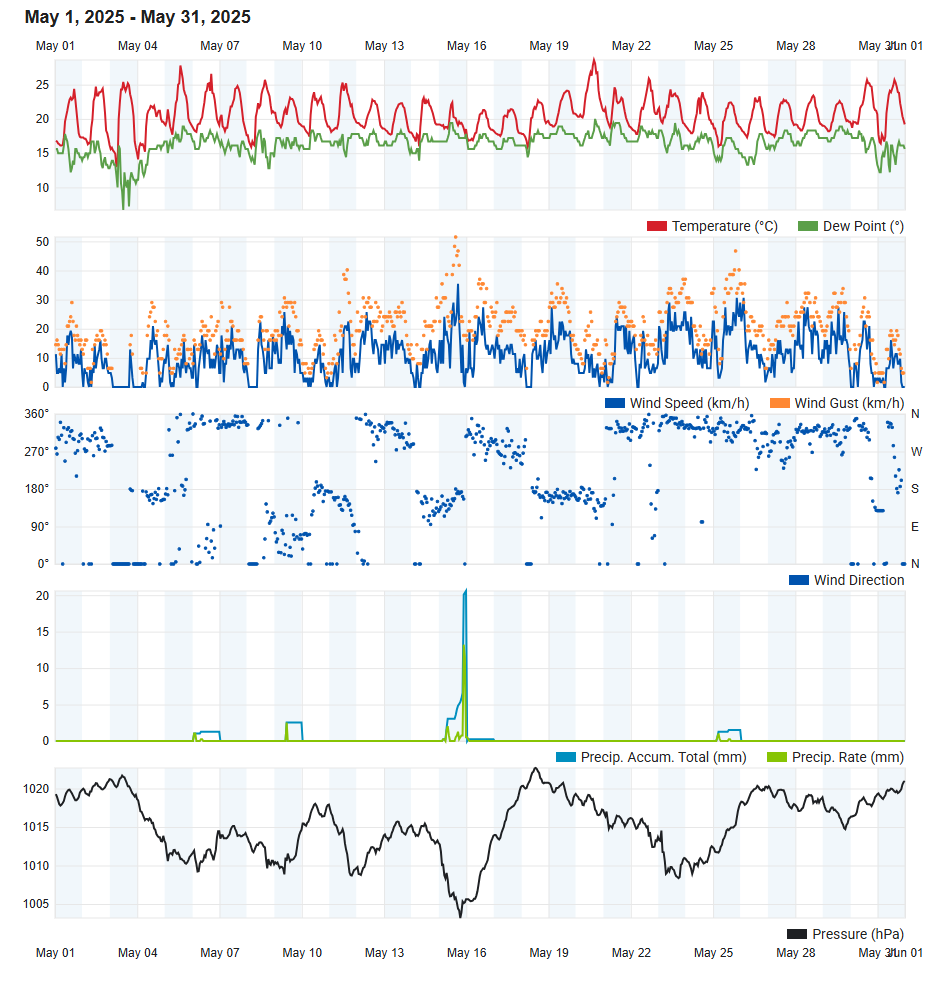
End of Month Reports

Warmer but Wetter than Average in May 2025

Air Temperature

Highest Maximum 28.6°C 20th
Lowest Maximum 21.3°C 16th
Highest Minimum 20.2°C 20th
Lowest Minimum 12.2°C 3rd

Mean Maximum 24.1°C
Mean Minimum 17.0°C
Mean 20.5°C

Relative Humidity

Highest Relative Humidity 97% Numerous days
Lowest Relative Humidity 29% 3rd

Mean Relative Humidity 79.0%

Wind

Highest Gust 51.5km/h 15th

Mean Wind Speed 11.8km/h
Most Frequent Wind Direction Northwest

Atmospheric Pressure

Highest Atmospheric Pressure 1022.7hPa 18th
Lowest Atmospheric Pressure 1002.5hPa 15th

Mean Atmospheric Pressure 1015.2hPa

Precipitation

Total Rainfall During May 2025 35.3 mm
Total Rainfall Since Last 01/09 480.9 mm

Highest 24 Hour Total 29.0 mm 15th

Rain Days 5 days
Thunderstorm Days 3 days
Hail Days 0 days

Rainfall Events

6/5/2025 1.4 mm A.M. Thunderstorms
9/5/2025 2.8 mm Thunderstorm
15/5/2025 29.0 mm Showers; Distant Thunder; P.M. Thunderstorm
16/5/2025 0.3 mm A.M. Isolated Shower
25/5/2025 1.8 mm A.M. Isolated Showers

May 2025 Compared to the Climate Means

  Climate Mean May 2025 Anomaly
Mean Maximum Temperature 23.9°C 24.1°C  +0.2°C  
Mean Minimum Temperature 15.9°C 17.0°C +1.1°C 
Mean Temperature 19.9°C 20.5°C +0.6°C 
Mean Relative Humidity 74.5% 79.0% +4.5% 
Mean Atmospheric Pressure 1015.9hPa 1015.2hPa -0.7hPa 
Total Rainfall 9.8 mm 35.3 mm +25.5 mm
Total Rainfall Since Last 01/09 514.5 mm 480.9 mm -33.6 mm
Total Rain Days 4 days 5 days +1 day
Total Thunderstorm Days 1 day 3 days +2 days
Total Hail Days 0 days 0 days /

Warmer but Wetter than Average in May 2025

May was a mixed bag of spring weather. As spring settled in across the Maltese Islands, May was characterized by a mix of pleasant weather and occasional instability, including a day of intense thundery downpours. Despite the occasional unsettled spell, last month was warmer than average.

35.3 mm of rain was recorded at our weather station in May. The national mean was around this value too. This was almost four times the climate norm. There were five days with rain over the course of the month. One of them accounted for the vast majority of this rainfall: a staggering 29 mm of it. This was from a series of thundery downpours which affected all of the Maltese Islands on the 15th. The 15th also accounted for the month’s highest wind gust. That day was characterized by a near gale from the South Southeast. The remaining rainy days brought elevated thunderstorms with lots of loud thunder but modest rainfall accumulations. Copious amounts of fine desert sand were deposited by the lighter thunderstorms.

May’s mean temperature of 20.528 was just over half a degree warmer than the climate norm. While daytime temperatures were only marginally warmer than average, nights were warmer by just over a degree. The warmest day and night were those of the 28th with a maximum and minimum of  28.6°C and 20.2°C respectively. The coldest night came earlier in the month, on the 3rd April, with a minimum temperature of 12.2°C on a calm and clear night.

Levels of relative humidity were also noticeably elevated at 79.0%; owing to the wetter than average conditions.

Rainfall Totals around the Maltese Islands in May 2025 (and since last September 1st): 

Kerċem: 35.3 mm (480.9 mm)

Victoria: 24.4 mm (493.4 mm)

Marsalforn: 29.1 mm (431.8 mm)

Xewkija: 31.3 mm (362.5 mm)

Nadur: 32.3 mm (483.1 mm)

Għajnsielem: 25.9 mm (421.0 mm)

Mellieħa: 35.2 mm (375.8 mm)

Buġibba: 36.6 mm (369.9 mm)

Mġarr: 33.9 mm (450.0 mm)

Naxxar: 32.3 mm (460.0 mm)

Mosta: 35.4 mm (459.4 mm)

Dingli: 36.1 mm (569.3 mm)

Pembroke: 38.9 mm (485.4 mm)

Msida: 36.9 mm (546.3 mm)

Sliema: 36.1 mm (448.4 mm)

Valletta: 32.8 mm (457.8 mm)

Fgura: 45.0 mm (547.4 mm)

Żejtun: 38.8 mm (499.2 mm)

Żabbar: 37.1 mm (552.2 mm)

Imqabba: 40.9 mm (529.1 mm)

Siġġiewi: 41.9 mm (485.7 mm)

Żurrieq: 29.3 mm (473.4 mm)

Marsaxlokk: 28.8 mm (383.8 mm)

NATIONAL MEAN: 34.2 mm (466.0 mm)