


Air Temperature
| Highest Maximum | 19.7°C | 4th |
| Lowest Maximum | 14.6°C | 27th |
| Highest Minimum | 14.4°C | 18th |
| Lowest Minimum | 7.0°C | 22nd |
| Mean Maximum | 16.8°C |
| Mean Minimum | 10.4°C |
| Mean | 13.6°C |
Relative Humidity
| Highest Relative Humidity | 95% | Numerous days |
| Lowest Relative Humidity | 54% | 22nd |
| Mean Relative Humidity | 81.7% |
Wind
| Highest Gust | 56.3km/h | 27th |
| Days with Force 5 (29 – 38kph) | 11 days |
| Days with Force 6 (39 – 49kph) | 6 days |
| Days with Force 7 (50 – 61kph) | 2 days |
| Days with Force 8 (62 – 74kph) | 0 days |
| Days with Force 9 (75 – 88kph) | 0 days |
| Days with Force 10+ (89kph+) | 0 days |
| Mean Wind Speed | 11.5km/h |
| Most Frequent Wind Direction | Southeast |
Atmospheric Pressure
| Highest Atmospheric Pressure | 1026.9hPa | 4th |
| Lowest Atmospheric Pressure | 997.6hPa | 16th |
| Mean Atmospheric Pressure | 1015.1hPa |
Precipitation
| Total Rainfall During March 2026 | 35.2 mm |
| Total Rainfall Since Last 01/09 | 517.7 mm |
| Highest 24 Hour Total | 14.8 mm | 14th |
| Rain Days | 14 days |
| Thunderstorm Days | 3 days |
| Hail Days | 1 day |
Rainfall Events
| 02/03/2026 | 0.3 mm | Heavy Dewfall |
| 06/03/2026 | 2.3 mm | Isolated Showers |
| 09/03/2026 | 0.5 mm | Isolated Light Rain |
| 10/03/2026 | 0.5 mm | Isolated Light Rain |
| 14/03/2026 | 14.8 mm | Steady Rain; Isolated Thunderstorm |
| 15/03/2026 | 2.5 mm | Showers |
| 16/03/2026 | 0.5 mm | Isolated Light Rain; Distant Thunder |
| 17/03/2026 | 0.5 mm | Isolated Light Rain |
| 22/03/2026 | TR mm | Isolated Light Rain |
| 23/03/2026 | 8.8 mm | Morning Shower |
| 24/03/2026 | 0.3 mm | Light Afternoon Rain; Distant Thunderstorm with Hail |
| 27/03/2026 | 2.9 mm | Showers |
| 28/03/2026 | 0.3 mm | Isolated Light Rain |
| 30/03/2026 | 0.0 mm | Distant Isolated Light Rain |
| 31/03/2026 | 1.0 mm | Isolated Light Rain |
March 2026 Compared to the Climate Means
| Climate Mean | March 2026 | Anomaly | |
| Mean Maximum Temperature | 17.1°C | 16.8°C | -0.3°C |
| Mean Minimum Temperature | 10.9°C | 10.4°C | -0.5°C |
| Mean Temperature | 14.0°C | 13.6°C | -0.4°C |
| Mean Relative Humidity | 78.1% | 81.7% | +3.6% |
| Mean Atmospheric Pressure | 1017.3hPa | 1015.1hPa | -2.2Pa |
| Total Rainfall | 40.3 mm | 35.2 mm | -5.1 mm |
| Total Rainfall Since Last 01/09 | 487.8 mm | 517.7 mm | +30.2 mm |
| Total Rain Days | 9 days | 14 days | +5 days |
| Total Thunderstorm Days | 2 days | 3 days | +1 day |
| Total Hail Days | 1 day | 1 day | / |
Colder than Winter in March 2026
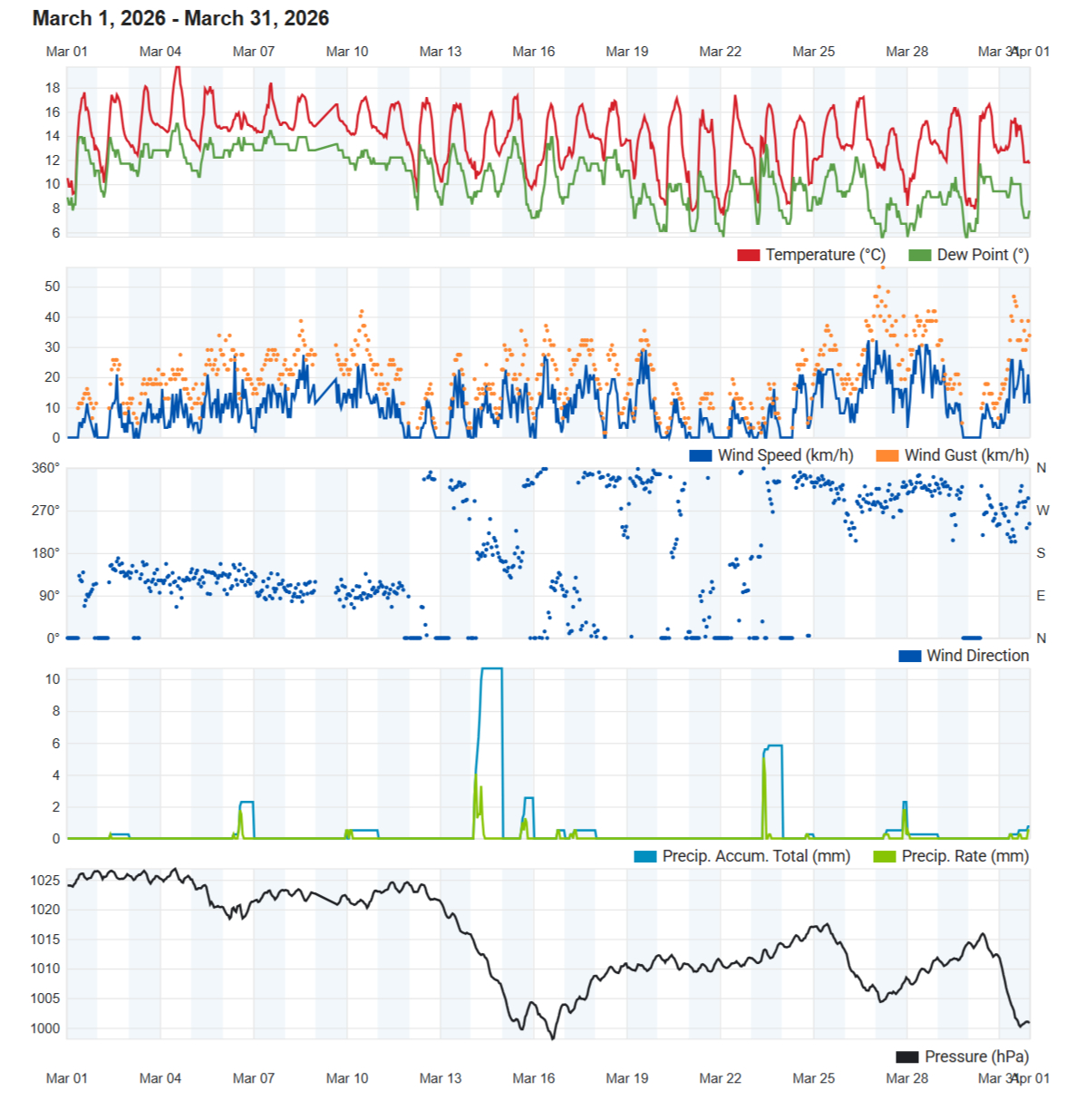
March 2026 marked a clear transition away from the anomalous warmth of mid-winter, with temperatures easing back toward – and slightly below – seasonal norms, while humid and unsettled conditions persisted across the Maltese Islands. In fact, March was cooler than the preceding three months of meteorological winter.
The mean air temperature stood at 13.6°C, 0.4°C cooler than the climatological average. Both daytime and night-time temperatures contributed to this slight negative deviation, with a mean maximum of 16.8°C and a mean minimum of 10.4°C standing at 0.3°C and 0.5°C below the norm. This contrasts notably with the warmth observed in January and February. The warmest day of the month reached 19.7°C on the 4th, while the lowest minimum of 7.0°C was recorded on the 22nd during a cooler, drier interval.
Despite the marginally cooler thermal profile, the atmosphere remained consistently moist, with mean relative humidity at 81.7%, exceeding the long-term average by 3.6%. Frequent cloud cover and humid air masses continued to this.
Atmospheric pressure averaged 1015.1 hPa, some 2.2 hPa below normal, indicating that cyclonic influence, although weaker than in previous months, maintained a presence. Pressure ranged from 1026.9 hPa on the 4th to 997.6 hPa on the 16th, the latter associated with a more organized disturbance mid-month.
Wind patterns shifted once again, with the southeasterly direction re-emerging as dominant, suggesting a return to Mediterranean-driven airflow regimes. Mean wind speed decreased to 11.5 km/h, lower than in February, but the month remained notably breezy. A total of 19 days recorded Force 5 or stronger winds, including 11 days at Force 5, 6 days at Force 6, and 2 days at Force 7. The strongest gust reached 56.3 km/h on the 27th.
Rainfall during March amounted to 35.2 mm, slightly below the climatological mean (−5.1 mm), but with a notably higher frequency of rain days. A total of 14 rain days were recorded – five above average – indicating that precipitation was spread across multiple days rather than concentrated in significant events. The highest 24-hour total was 14.8 mm on the 14th, associated with steady rain and an isolated thunderstorm.
Convective activity was modest, with 3 thunderstorm days (slightly above average) and 1 hail day, consistent with seasonal norms. Events on the 14th–16th and again around the 23rd–24th suggest weak instability embedded within passing disturbances, rather than organized severe convection.
The rainfall distribution across the islands was relatively balanced, with a national mean of 36.8 mm. Some local enhancement was observed in areas such as Mġarr (62.4 mm), Imqabba (48.4 mm), and Buġibba (46.2 mm), while lower totals occurred in Valletta (27.5 mm) and Żabbar (25.9 mm). These variations likely reflect localized convective effects rather than strong orographic forcing, given the more variable wind regime.
Cumulatively, rainfall since 1 September reached 517.7 mm, maintaining a +30.2 mm surplus despite the slightly drier conditions in February and March. This confirms that the hydrological season remained above average overall.
March weather indicates that true settled spring conditions are yet to establish, with the atmosphere remaining dynamically active and moisture-laden.
Rainfall Totals around the Maltese Islands in March 2026 (and since last September 1st):
Kerċem: 35.2 mm (517.7 mm)
Victoria: 35.3 mm (521.2 mm)
Marsalforn: 32.4 mm (466.0 mm)
Xewkija: 28.5 mm (445.9 mm)
Nadur: 35.5 mm (469.3 mm)
Għajnsielem: 36.5 mm (473.2 mm)
Mellieħa: 33.6 mm (346.8 mm)
Buġibba: 46.2 mm (337.8 mm)
Mġarr: 62.4 mm (484.3 mm)
Naxxar: 43.8 mm (404.6 mm)
Mosta: 42.6 mm (371.8 mm)
Dingli: 34.6 mm (524.1 mm)
Pembroke: 35.4 mm (414.9 mm)
Msida: 41.1 mm (434.7 mm)
Sliema: 35.3 mm (431.2 mm)
Valletta: 27.5 mm (393.1 mm)
Fgura: 44.7 mm (441.6 mm)
Żejtun: 33.1 mm (398.8 mm)
Żabbar: 25.9 mm (361.8 mm)
Imqabba: 48.4 mm (526.4 mm)
Siġġiewi: 37.3 mm (518.7 mm)
Żurrieq: 35.4 mm (522.1 mm)
Marsaxlokk: 31.1 mm (363.1 mm)
NATIONAL MEAN: 36.8 mm (440.1 mm)